Concrete is arguably the most widely used construction material on the planet, but it is not indestructible. Over time, every concrete structure develops some form of distress — cracks, spalls, delamination, or surface wear. The key is not to panic when you see it, but to diagnose the root cause and choose the right repair method. I have worked on dozens of repair projects across industrial plants, residential towers, and infrastructure projects, and one truth holds: a repair is only as good as the preparation and material selection that goes into it.
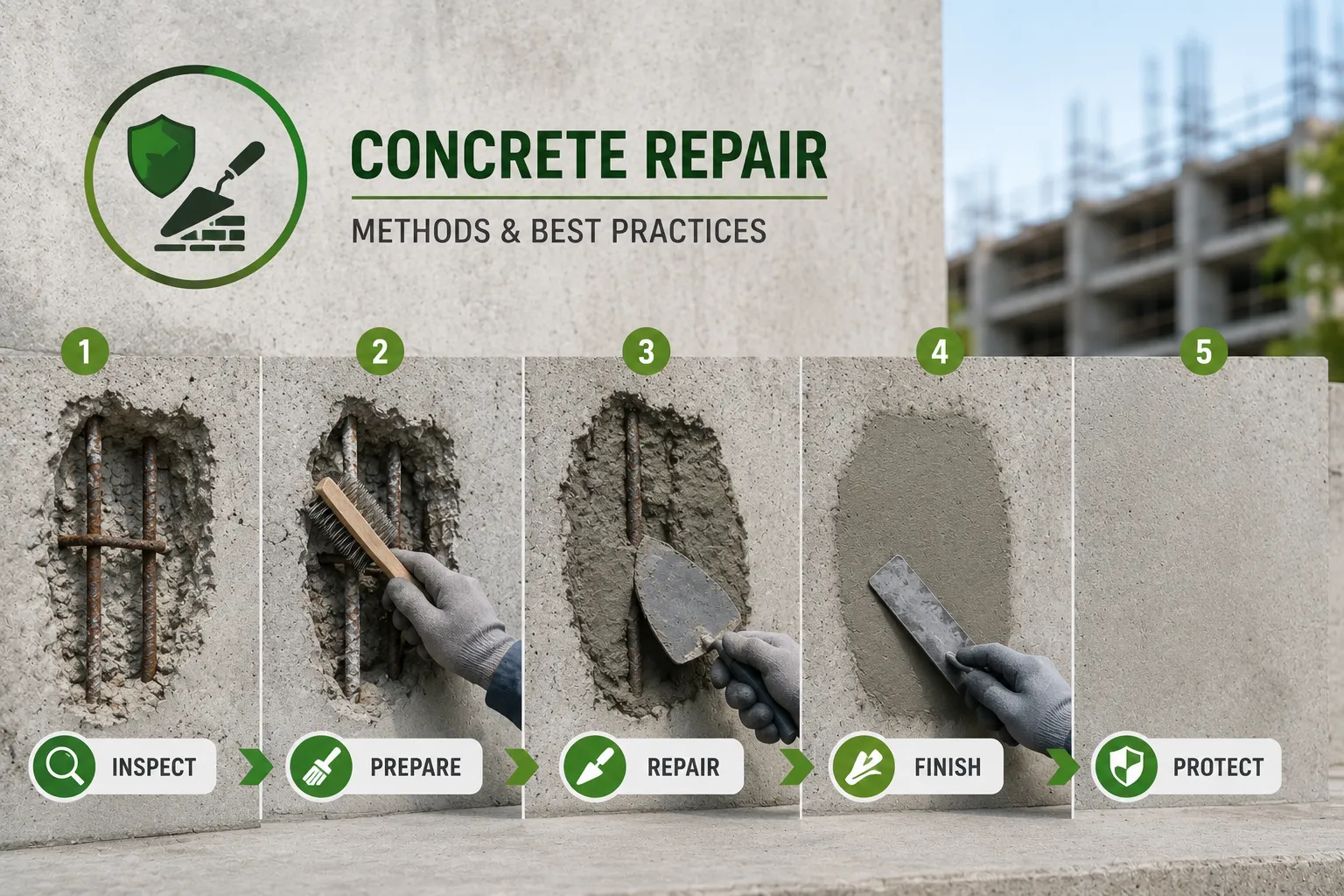
Why Concrete Deteriorates
Understanding the cause of deterioration is the first step. Concrete fails for many reasons — corrosion of embedded steel reinforcement, freeze-thaw cycles, chemical attack, alkali-aggregate reaction, or simple mechanical damage from overloading. In India, the most common culprit I encounter is corrosion of reinforcement due to carbonation or chloride ingress, especially in coastal regions and urban environments with high pollution levels. When rebar rusts, it expands to several times its original volume, creating tensile stresses that crack and spall the surrounding concrete.
Moisture is almost always a factor. Even well-compacted concrete with a low water-cement ratio will eventually allow moisture and oxygen to reach the steel if the cover is insufficient. That is why waterproofing and proper cover maintenance are not optional — they are fundamental to concrete durability.
Surface Preparation
I cannot overstate the importance of surface preparation. In my experience, more than 70% of premature repair failures trace back to inadequate surface preparation. You cannot simply trowel repair mortar over a dirty, damp, or weak substrate and expect it to bond.
Start by removing all unsound concrete. Use a hammer and chisel for small areas, or a breaker and scabbler for larger patches. The substrate must be free of oil, grease, dust, and laitance. For structural repairs, I recommend hydro-demolition or abrasive blasting to achieve a rough, clean surface with an open pore structure. The surface should be saturated surface dry (SSD) before applying cementitious repair materials — damp but with no standing water. If you are using an epoxy-based repair, the surface must be dry, typically below 4% moisture content.
Repair Mortar Selection
Not all repair mortars are the same, and using the wrong one is a recipe for debonding and re-repair within months. The selection depends on the repair depth, structural requirement, and exposure condition.
For shallow surface repairs (5–30 mm depth), a polymer-modified cementitious mortar with low shrinkage is ideal. These mortars contain acrylic or SBR latex that improves adhesion, reduces water absorption, and enhances flexural strength. For deeper repairs (30–100 mm), a fibre-reinforced, shrinkage-compensated mortar is needed. When the repair involves reinstating structural capacity, you should use a high-strength, flowable grout or micro-concrete with compressive strength above 50 MPa.
I have seen cases where specifiers used a cheap cement-sand mix for a deep patch on a bridge pier, and within one monsoon season, the patch had debonded and fallen off. The savings on material cost were negligible compared to the cost of rework and traffic disruption. Always match the repair material's modulus of elasticity, thermal expansion coefficient, and permeability to the parent concrete as closely as possible.
Crack Repair Methods
Cracks in concrete can be active or dormant. An active crack — one that is still moving due to thermal or structural movements — needs a flexible sealant or a routed-and-sealed joint. A dormant, stable crack can be structurally repaired by epoxy injection or cementitious grouting.
For cracks wider than 0.3 mm, epoxy injection is the gold standard. Low-viscosity epoxy is injected under pressure into the crack, restoring the concrete's tensile strength and preventing water ingress. For wider cracks or those with water leakage, polyurethane injection is more appropriate because it reacts with water to expand and form a flexible seal. In foundation walls or retaining structures where hydrostatic pressure is present, I always recommend PU injection over epoxy.
For non-structural surface cracks (hairline crazing), a simple brush-applied epoxy sealer or cementitious coating is sufficient. The important thing is to seal them early — before moisture and chlorides find their way in.
Structural Strengthening
When concrete has lost significant cross-section or load-bearing capacity due to deterioration, simple patching is not enough. The structure needs strengthening. Common techniques include steel plate bonding, section enlargement with shotcrete or micro-concrete, and external post-tensioning. In recent years, carbon fibre reinforced polymer (CFRP) wrapping has become the preferred method for columns, beams, and slabs because of its high strength-to-weight ratio, corrosion resistance, and ease of application.
I worked on a project where an industrial warehouse column had spalled down to the rebar due to years of chemical exposure. We jacketed it with a high-strength micro-concrete and wrapped the top portion with CFRP. The column tested to a higher load capacity than the original design. That is the satisfaction of good concrete repair — you do not just restore; you can improve.
How do I know if a crack is active or dormant?
Install a crack monitoring gauge or a simple glass tell-tale across the crack. If the tell-tale cracks within 30 days, the crack is active and should be treated as a movement joint rather than structurally injected.
Can concrete repair mortar be applied in cold weather?
Most cementitious mortars should not be applied below 5°C. The hydration reaction slows significantly, leading to low early strength and potential frost damage. Use accelerated repair mortars or postpone the repair until temperatures rise.
Is it necessary to apply a primer before repair mortar?
Yes, for most structural repairs. A bonding primer or slurry coat ensures adhesion between the old concrete and the new mortar. Skipping this step is the fastest way to get a debonded repair.