Few debates in the waterproofing world generate as much discussion as the choice between liquid applied and sheet applied membranes. Both systems have been used successfully for decades, and both have passionate advocates. Having worked with both systems across hundreds of projects — from basement waterproofing in high-rise towers to terrace waterproofing in luxury villas — I can tell you that there is no universal "best" option. The right choice depends on the substrate, the structural design, the site conditions, the available labour skill, and the budget.
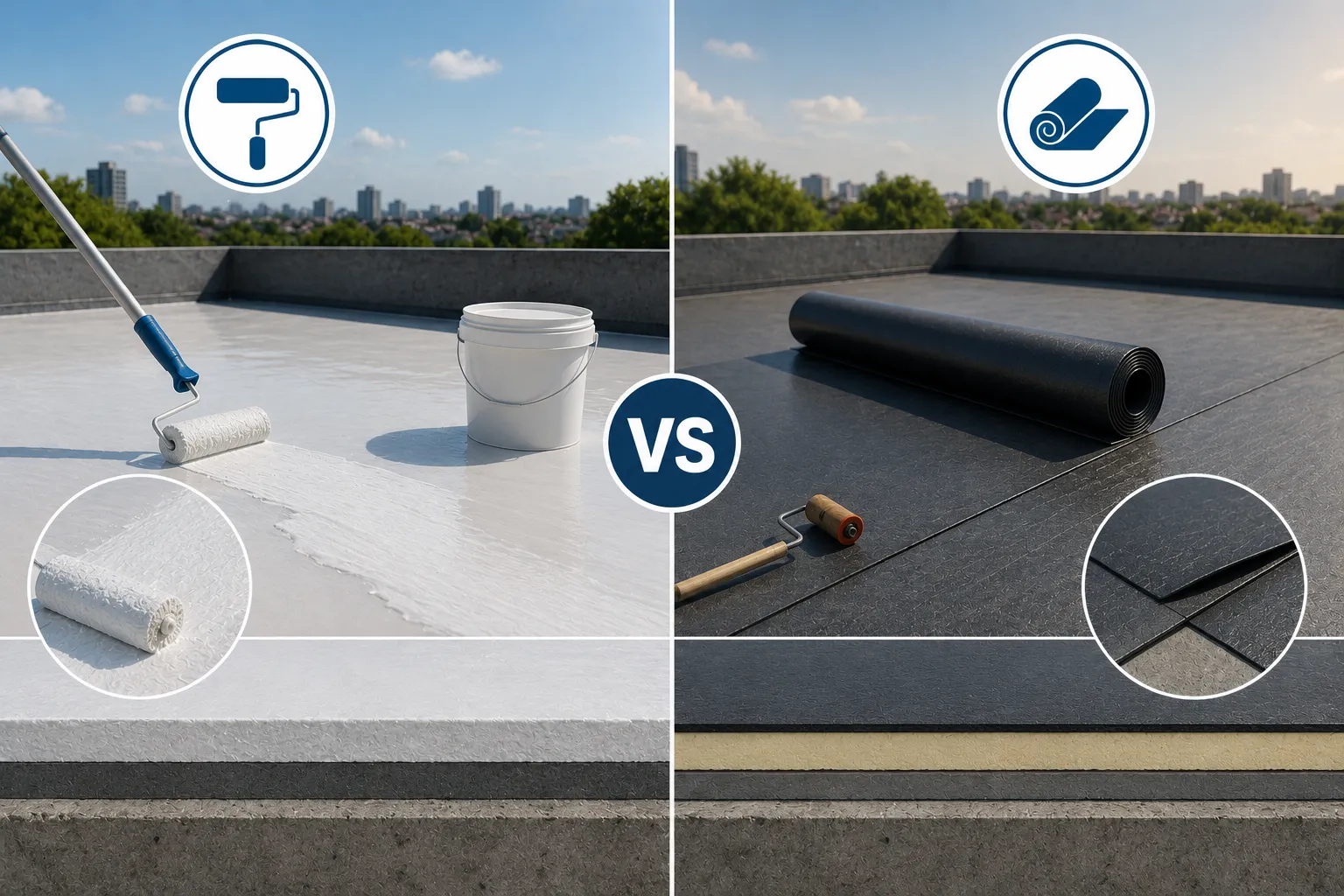
Liquid Applied Membranes
Liquid applied membranes are cold-applied or hot-applied resins that cure to form a seamless elastomeric waterproofing layer. They include polyurethane, acrylic, epoxy, and bituminous (polymer-modified bitumen) formulations. The biggest advantage is seamless application — there are no laps or joints to fail, which is the most common weakness in sheet systems. Liquid membranes bond directly to the substrate, forming a monolithic barrier that follows every contour, pipe penetration, and corner.
Application is typically by brush, roller, or spray. Coverage rates depend on the specified dry film thickness — typically 1.0–2.5 mm for above-grade applications and 2.0–4.0 mm for below-grade. Most systems require two or three coats, often with a reinforcing fabric (polyester fleece) sandwiched between coats at critical areas like cracks, joints, and transitions.
I have used liquid polyurethane membranes extensively on terrace gardens and podium decks where complex geometries and multiple penetrations make sheet application impractical. The ability to apply around drain pipes, upstand walls, and planters in one continuous operation is a significant time saver.
Sheet Applied Membranes
Sheet applied membranes are pre-manufactured rolls of waterproofing material that are adhered or mechanically fastened to the substrate. Common types include PVC, TPO, HDPE, EPDM, and bituminous self-adhesive sheets. The key advantage is consistent, factory-controlled thickness — you know exactly what you are getting. No mixing, no curing time, and less dependence on applicator skill for the material quality itself.
Sheet membranes are particularly well-suited for large, flat roof areas and below-grade horizontal applications where the substrate is uniform and there are few penetrations. Self-adhesive bituminous sheets are popular for residential terrace waterproofing because they are relatively easy to install and provide good puncture resistance.
However, sheets have a fundamental weakness: every lap joint and edge termination is a potential leak path. The number of joints in a typical sheet installation is enormous — each roll is typically 1–2 metres wide and 15–20 metres long, so a 100 m² roof may have 50–100 linear metres of lapped joints. Each lap must be clean, dry, and properly bonded or welded, or it will fail. In my experience, more than 80% of sheet membrane failures occur at laps and edge terminations — not through the sheet itself.
Key Comparison Factors
Substrate preparation: Liquid membranes require a clean, dry, and primed substrate, but surface irregularities up to 2–3 mm are acceptable because the liquid fills them. Sheet membranes require a much flatter surface — typically within 2 mm over a 3-metre straightedge — because bumps and hollows prevent proper bonding and create voids where water can travel laterally behind the membrane.
Weather sensitivity: Liquid membranes are sensitive to humidity and temperature during application and curing. If rain is forecast within 4–6 hours, do not apply. Sheet membranes, especially torch-applied or self-adhesive types, can be installed in light rain if the substrate is dry and the laps are properly sealed.
Repairability: Liquid membranes are easy to repair — clean the damaged area, apply a fresh coat, and the repair integrates seamlessly. Sheet membranes require cutting out the damaged section, applying a patch with sealed edges, which always creates additional potential leak paths.
Cost: For simple, large-area applications, sheet membranes tend to be more economical. For complex roofs with many penetrations, upstands, and details, liquid applied works out cheaper because of reduced labour time and fewer materials.
When to Choose Liquid Applied
Choose liquid applied membranes for: complex roof shapes with multiple penetrations, upstands, and curbs; areas where the substrate condition is rough or uneven; structures with many movement joints that need flexible detailing; balcony and terrace waterproofing where tiles will be laid over the membrane; and repair work where the existing substrate already has coatings or irregular surfaces.
When to Choose Sheet Applied
Choose sheet applied membranes for: large, flat, unobstructed roof areas; below-grade blinding concrete and raft slab waterproofing where the membrane will be protected by a screed or drainage board; green roofs requiring root-resistant sheets; and projects where consistent material thickness is critical and site QA resources are limited.
Are liquid applied membranes more expensive than sheet?
For simple large roofs, sheet membranes are usually 10–20% cheaper in material cost. For complex roofs, liquid applied is often more economical overall because of faster installation and less waste. Compare installed cost, not material cost alone.
How long do waterproofing membranes last?
Both systems, when properly installed and protected, have a service life of 15–25 years. Liquid polyurethane membranes may need a topcoat refresh after 10–12 years if exposed to UV. Sheet membranes (PVC, TPO) may embrittle over time and become less flexible.
Can I apply tiles directly over a liquid membrane?
Yes, but only after the membrane has fully cured (typically 24–72 hours). Use a flexible tile adhesive to accommodate differential movement between the tile and the membrane. For sheet membranes, tiles should be laid on a screed or concrete topping to avoid puncturing the sheet.