A damp or leaking basement is one of the most frustrating problems a building owner can face. Water intrusion not only damages stored goods and finishes but also leads to mould growth, structural deterioration, and unhealthy indoor air. The Indian monsoon season makes basement waterproofing particularly critical, as heavy rainfall can raise the water table rapidly and overwhelm inadequate protection systems. Yet many basement waterproofing solutions sold in the market are temporary fixes that address symptoms rather than root causes.
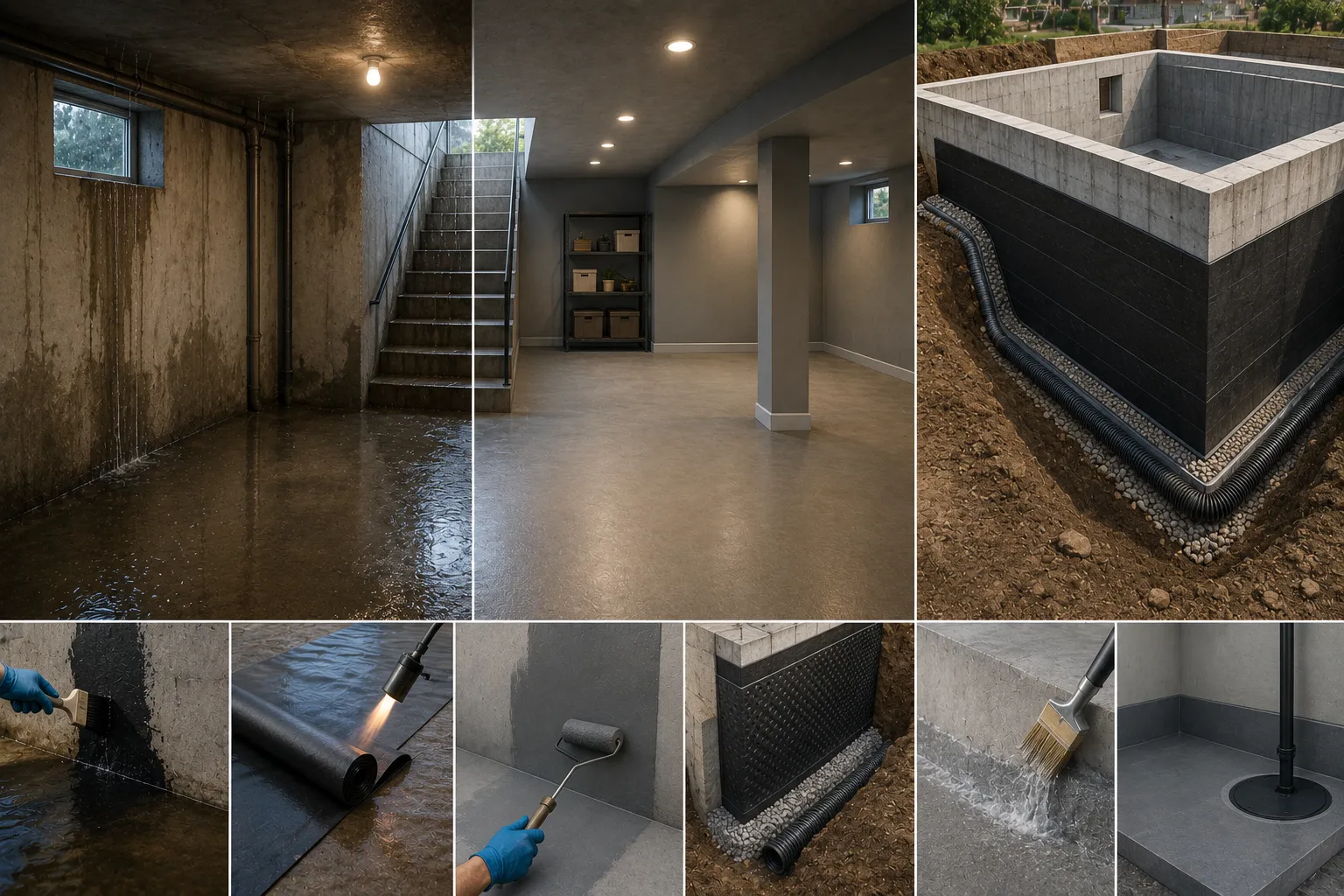
This article examines basement waterproofing methods that genuinely work, from internal sealers and coatings to external drainage systems and advanced membrane technologies. We will explain how each method works, where it is best applied, and what level of protection you can realistically expect. Whether you are waterproofing a new basement during construction or retrofitting an existing wet basement, understanding these options will help you make an informed decision.
Understanding Basement Moisture
Before choosing a waterproofing method, it is essential to understand where the moisture is coming from. Basement water problems fall into three main categories. Groundwater ingress occurs when the water table rises above the level of the basement floor, creating hydrostatic pressure that forces water through cracks, joints, and porous concrete. Surface water infiltration happens when poor drainage around the foundation allows rainwater to pool against basement walls and seep through. The third category is internal condensation, which is often mistaken for a leak but is actually caused by warm humid air meeting cool basement surfaces.
The correct solution depends on the type and severity of the moisture problem. A simple damp wall caused by condensation requires ventilation and insulation, not a membrane system. A crack that weeps water only during heavy rain may be fixed with an injection repair. But a basement that floods regularly during the monsoon almost certainly needs a combination of external drainage and membrane protection. A professional assessment using moisture meters and crack monitoring is the first step in any successful waterproofing project.
Internal Waterproofing Methods
Internal waterproofing refers to products applied to the inside surfaces of the basement walls and floor. These are generally easier and less expensive to install than external systems because they do not require excavation around the foundation. However, internal systems work by containing moisture rather than stopping it at the source, so they are most effective for managing dampness and minor seepage rather than active leaks under pressure.
Cementitious waterproofing coatings are the most common internal solution. These are powder blends of Portland cement, fine sand, and chemical additives that are mixed with water and applied like plaster. When applied to a clean, damp substrate, the coating forms a crystalline bond with the concrete that can resist moderate hydrostatic pressure. Cementitious coatings are breathable, which allows any moisture trapped in the wall to evaporate rather than build up behind the coating. They are best suited for basement walls that show efflorescence or damp patches but do not have active water flow.
Epoxy and polyurethane injection is another internal method used for sealing individual cracks and joints. Low-viscosity epoxy is injected under pressure into cracks as narrow as 0.1 mm. The resin penetrates deep into the crack, bonds to the concrete, and forms a rigid structural seal. Polyurethane injection resins are flexible and expand on contact with water, making them ideal for stopping active leaks in expansion joints and around pipe penetrations. Both methods are highly effective for targeted repair but do not address overall wall porosity.
Silicate-based penetrating sealers are a newer class of internal waterproofing. These liquids are applied to the concrete surface, where they react with free calcium hydroxide to form a crystalline gel that fills the capillary pores. The treatment becomes a permanent part of the concrete matrix and can withstand high hydrostatic pressure. The advantage of penetrating sealers is that they do not alter the appearance or texture of the wall and they allow vapour transmission. They are an excellent choice for basement walls that are structurally sound but porous.
External Waterproofing Methods
External waterproofing, also called tanking, involves applying a protective barrier to the outside face of the basement walls and under the floor slab. This is the most reliable method for preventing groundwater ingress because it stops water at the structure's perimeter before it can reach the concrete. The main drawback is that external waterproofing requires excavation around the foundation, which is disruptive and expensive, especially for existing buildings.
Sheet membrane systems are widely used for external waterproofing. These are preformed sheets of modified bitumen, PVC, or HDPE that are bonded to the prepared external wall surface using a torch-on or self-adhesive method. The membranes are flexible enough to accommodate minor structural movement and are highly resistant to chemical attack from soil-borne contaminants. Proper detailing at joints, corners, and service penetrations is critical, which is why external membrane installation should always be carried out by trained applicators.
Liquid-applied membranes are an alternative to sheet systems. These are single-component or two-component polyurethane or acrylic resins that are sprayed or rolled onto the wall. They form a seamless monolithic coating with no joints, which eliminates the risk of failure at membrane laps. Liquid membranes are particularly useful on irregular wall surfaces where sheet membranes are difficult to fit. They cure to form a rubber-like film that bridges minor cracks and remains flexible over a wide temperature range.
Bentonite clay panels offer a self-sealing external waterproofing solution. These panels contain sodium bentonite clay sandwiched between two layers of geotextile fabric. When the clay contacts water, it expands up to 15 times its dry volume to form a dense, impermeable gel that seals the wall. Bentonite systems are self-healing, meaning that if the panel is punctured during backfilling, the clay will swell and close the hole. They are commonly used below grade where positive hydrostatic pressure is present.
Drainage Systems
No basement waterproofing system is complete without proper drainage. Even the best membrane will eventually fail if water is allowed to pool against it for extended periods. Drainage systems reduce the hydrostatic pressure on the structure by intercepting groundwater and directing it away from the foundation.
The most important drainage element is the perimeter drain, also called a French drain or footing drain. This is a perforated pipe laid in a gravel trench around the outside of the foundation at the level of the footing. The pipe collects groundwater and carries it to a sump pit or storm drain. A geotextile filter fabric wraps the gravel to prevent soil fines from clogging the pipe. Perimeter drains should be inspected and cleaned periodically because silt buildup is a common cause of basement flooding in older buildings.
Interior drainage systems are used when exterior excavation is not feasible. A channel drain is installed along the perimeter of the basement floor, just inside the wall. A polymer coating or membrane directs water that seeps through the wall down into the channel, which empties into a sump pump basin. The sump pump then discharges the water to the exterior at a safe distance from the building. Interior drainage systems are very effective for managing groundwater ingress in retrofits, but they do require a reliable backup pump in case of power failure during heavy storms.
Waterproofing Membranes
Waterproofing membranes are the backbone of any basement waterproofing system. They can be broadly classified into sheet membranes, liquid-applied membranes, and cementitious membranes. The choice depends on the substrate condition, the expected water pressure, the budget, and whether the application is new construction or retrofit.
For new construction, a combination of external sheet membrane and a below-slab vapour barrier provides the highest level of protection. The membrane is applied to the foundation walls before backfilling, and a heavy-gauge polyethylene or PVC vapour barrier is laid under the floor slab with sealed laps and penetration collars. This creates a complete waterproof envelope around the entire basement structure.
For retrofit projects where external excavation is not possible, cavity drain membranes offer an effective solution. These are dimpled HDPE sheets that are installed on the interior walls and floor. The dimples create an air gap between the membrane and the concrete, allowing any water that penetrates the wall to drain down to a perimeter channel without contacting the interior finishes. The membrane also provides a vapour barrier and can be finished with plasterboard or other wall coverings. Cavity drain systems are widely considered the most reliable retrofit solution because they do not rely on adhesion to potentially damp substrates.