If you have ever been on a construction site and wondered why some concrete pours like honey while others stiffen up within minutes, the answer usually comes down to one thing: admixtures. Concrete admixtures are ingredients added to the mix — besides water, cement, and aggregates — to modify its properties in the fresh or hardened state. They give you control where the basic concrete mix falls short. And in modern construction, they are not optional anymore. They are essential.
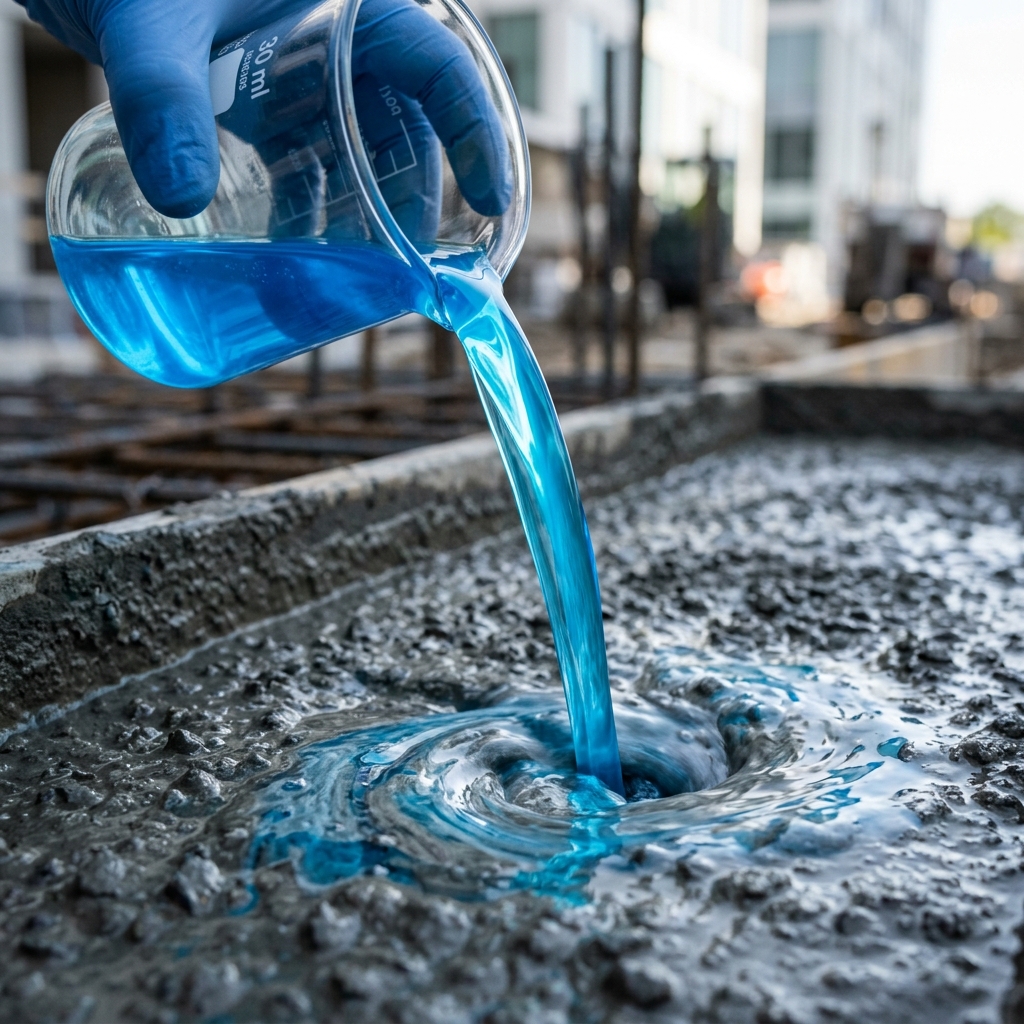
Whether you are pouring a high-rise column in Delhi summer or casting a precast element that needs to demold in six hours, there is an admixture designed to handle that specific problem. The trick is knowing which one to use and how much. Let us walk through the major categories so you can make the right call on your next project.
What Exactly Are Concrete Admixtures?
Admixtures are chemical formulations added to concrete during mixing. They are typically added in small quantities relative to the cement weight — usually 0.2% to 2% by weight of cement — but their effect on performance is dramatic. The right admixture can improve workability, accelerate or slow down setting time, increase strength, reduce water content, or enhance durability. The Indian standard IS 9103 and ASTM C494 classify them based on their function.
The admixture market in India has grown significantly over the last decade, driven by infrastructure projects like highways, metros, airports, and high-rise residential construction. Today, using admixtures is standard practice, not an exception.
Plasticizers and Superplasticizers — The Workability Enhancers
Plasticizers, also called water reducers, are the most commonly used admixtures. They work by dispersing cement particles in the mix, reducing inter-particle friction. This allows you to achieve the same workability with less water — typically a 5–10% reduction. That might not sound like much, but lower water content means stronger, more durable concrete.
Superplasticizers, or high-range water reducers, take this concept further. They can reduce water content by 20–30% while giving you a highly flowable mix. This is what makes self-compacting concrete possible. You will see superplasticizers used heavily in congested reinforcement areas, pumped concrete for high rises, and pre-stressed concrete members where high early strength is needed. The bases are typically sulfonated naphthalene formaldehyde (SNF), polycarboxylate ether (PCE), or melamine-based. PCE-based superplasticizers are currently the most advanced, offering excellent slump retention over longer transport distances.
Retarders — When You Need More Time
In hot weather concreting, the biggest enemy is the fast setting. When ambient temperatures cross 35°C, concrete can start losing slump within 15–20 minutes. That is where retarders step in. Retarding admixtures delay the hydration process of cement, giving you extra working time for placing, compacting, and finishing.
They are indispensable for large-area pours like raft foundations, bridge decks, and concrete pavements where the time gap between mixing and placing can be an hour or more. Common retarders include sugar-based compounds, lignosulfonates, and hydroxycarboxylic acids. A word of caution: overdosing can lead to excessive retardation, which may affect strength gain. Always follow the manufacturer's dosage recommendations.
Accelerators — Speed Up the Gain
Accelerators do the opposite of retarders. They speed up the setting time and early strength gain of concrete. This is extremely useful in cold weather concreting, where low temperatures slow down hydration, and in precast plants where fast mold turnover is a productivity necessity.
Calcium chloride is the traditional accelerator, but it has a downside — it can cause corrosion of steel reinforcement. That is why chloride-free accelerators based on calcium nitrate, calcium formate, or triethanolamine are preferred for reinforced concrete. Shotcrete applications for tunneling and slope stabilization rely heavily on rapid-setting accelerators that make concrete stick to vertical surfaces without sagging.
Waterproofing and Permeability-Reducing Admixtures
Concrete is naturally porous. Water and aggressive chemicals can penetrate through these pores, leading to reinforcement corrosion, efflorescence, and freeze-thaw damage. Waterproofing admixtures, also called permeability reducers, block or line these pores to make concrete less absorbent.
There are two main types: hydrophobic (water-repelling) and pore-blocking. Hydrophobic admixtures, often based on stearates or fatty acids, coat the pore walls so water cannot wet the surface. Pore-blocking admixtures use reactive chemicals that form crystalline deposits inside the capillaries, physically blocking water ingress. Crystalline technology has become quite popular for basement waterproofing and water-retaining structures because the self-healing effect can seal minor cracks that develop over time.
Air-Entraining Admixtures — Protection Against Freeze-Thaw
In colder regions, water trapped inside concrete expands when it freezes, creating internal pressure that cracks the concrete. Air-entraining admixtures introduce tiny, evenly distributed air bubbles into the mix. These bubbles act as pressure relief chambers — when water freezes and expands, it pushes into these voids instead of cracking the paste.
Application is common in concrete pavements, bridge decks, and dam spillways in cold climates. While this is more relevant in Himalayan regions and cold countries, it is still worth knowing about if your project is in a freeze-thaw zone.
Other Specialty Admixtures
The admixture family is large. Shrinkage-reducing admixtures minimize drying shrinkage cracking in slabs and pavements. Viscosity-modifying admixtures prevent segregation and bleeding in self-compacting and underwater concrete. Corrosion inhibitors like calcium nitrite extend the service life of reinforced concrete in marine and industrial environments. And then there are coloring agents, bonding admixtures, and fungicidal admixtures for specialized applications.
Each of these solves a specific problem, and the key is to identify your project's challenges early so you can select the right combination. In many cases, a blend of multiple admixtures is used to achieve the desired performance, but compatibility testing is crucial before going to full-scale production.
Dos and Don'ts When Using Admixtures
First, never exceed the recommended dosage. More is not better — it can cause segregation, excessive retardation, or strength loss. Always conduct trial mixes with the actual materials that will be used on site. Admixture performance varies with cement type, aggregate grading, temperature, and mixing time.
Second, add admixtures at the right time. Most are added with the mixing water, but some superplasticizers perform better when added after the other ingredients have been mixed for a short period (delayed addition). Third, store admixtures properly — extreme temperatures can degrade them. And finally, keep a log of dosages and batch records for quality control and troubleshooting.
Conclusion
Concrete admixtures have transformed the construction industry. They give engineers and contractors the ability to tailor concrete for specific site conditions, structural requirements, and performance expectations. From plasticizers for better workability to crystalline waterproofers for durability, each admixture plays a distinct role. The key to success is understanding the problem you are trying to solve and selecting the right product — not the most expensive or the cheapest, but the one that fits.
At Sterling Technotrade, our Techno Builders Solutions range covers all major admixture categories. If you need help selecting the right admixture for your project, get in touch with our technical team. We will help you get it right the first time.