Water infiltration is one of the most persistent threats to concrete structures. Over time, even tiny cracks and capillaries in concrete allow moisture to seep through, leading to reinforcement corrosion, spalling, and structural deterioration. Crystalline waterproofing offers a permanent solution to this problem by becoming an integral part of the concrete itself. Unlike surface-applied membranes that can peel or degrade over time, crystalline technology works from within, sealing the concrete against water ingress for the life of the structure.
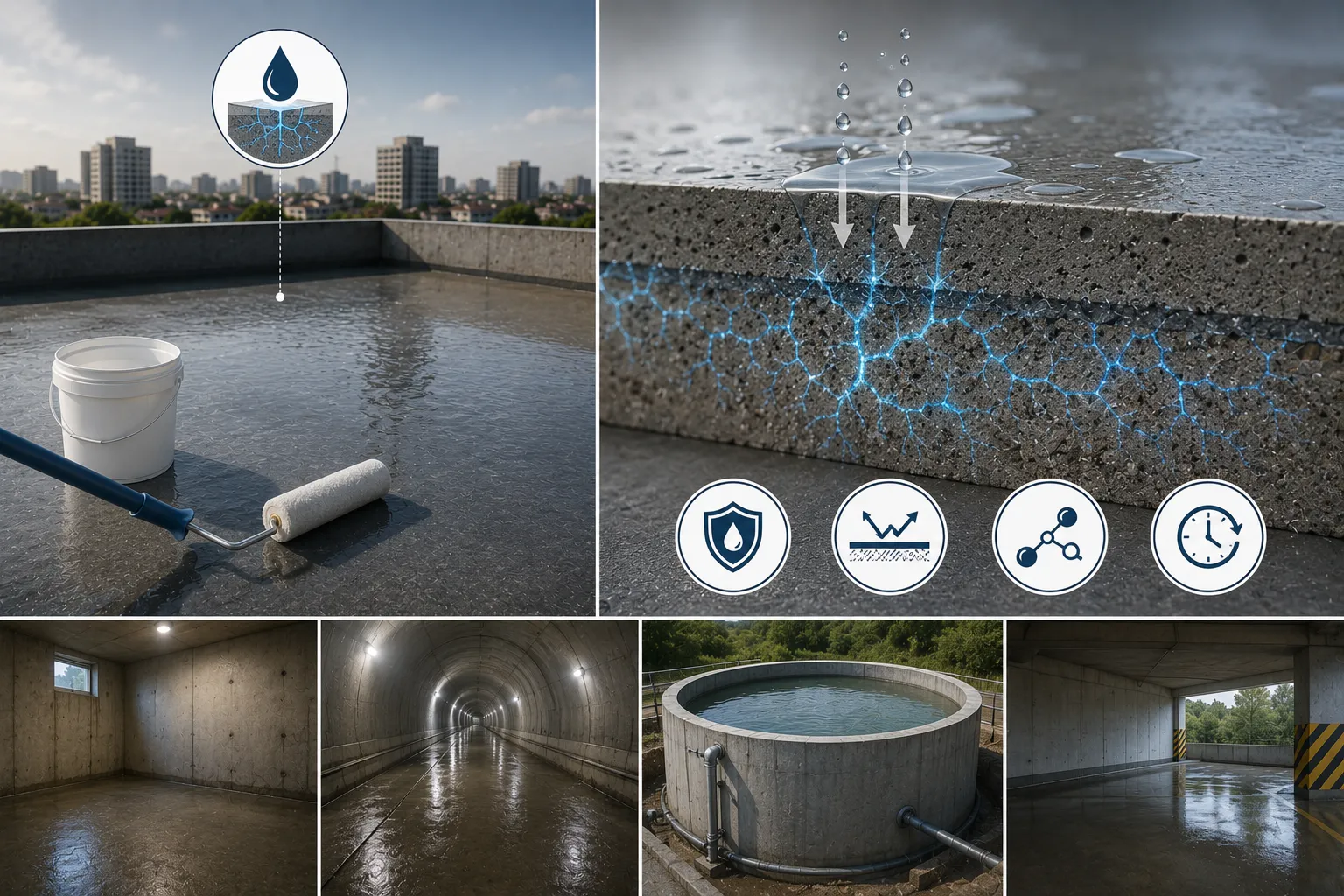
This technology has been used successfully for decades in some of the most demanding infrastructure projects around the world. Whether you are building a new basement, a water treatment plant, or a high-rise parking structure, crystalline waterproofing provides a level of protection that traditional methods simply cannot match. In this guide, we will explore what crystalline waterproofing is, how it works, and why your building needs it.
What Is Crystalline Waterproofing?
Crystalline waterproofing is a technology that uses chemical reactions within the concrete to form insoluble crystals that block pores, capillaries, and micro-cracks. These crystals grow deep into the concrete matrix, creating a permanent barrier against water and other liquids. The treatment can be applied as a dry shake during the construction phase, as a surface-applied coating, or as an admixture added directly to the concrete batch.
The active chemicals in crystalline products react with the free lime and moisture present in concrete to form a crystalline structure. This reaction happens naturally whenever the concrete comes into contact with water. The crystals fill voids and create a tight, impermeable seal that remains effective even under high hydrostatic pressure. Since the crystals become part of the concrete, they cannot be damaged by punctures, abrasion, or UV exposure the way surface membranes can.
Crystalline waterproofing is recognized by building codes and standards worldwide, including ACI, ASTM, and British Standards. It is a proven technology backed by extensive research and real-world performance data from projects spanning every climate and continent.
How Does Crystalline Waterproofing Work?
The mechanism behind crystalline waterproofing is a chemical reaction that transforms the concrete itself into a water-resistant material. The key ingredients in a crystalline formulation are proprietary active chemicals that are designed to react with calcium hydroxide and other byproducts of cement hydration.
When these chemicals encounter moisture, they catalyze a reaction that produces a non-soluble crystalline structure. This structure grows into the existing pores and capillaries of the concrete, eventually filling them completely. The crystals are so tightly integrated with the concrete that they become indistinguishable from the original matrix. Importantly, the reaction is not a one-time event. If the concrete develops a new crack later in its life and water enters, the dormant crystalline chemicals in the surrounding area will reactivate and grow new crystals to seal the crack.
This self-healing capability is what sets crystalline waterproofing apart from all other waterproofing methods. It provides ongoing protection that adapts to the natural movement and aging of the concrete structure.
- Chemicals react with calcium hydroxide and moisture in the concrete
- Insoluble crystals form deep within the capillary structure
- Crystals fill pores, cracks, and voids up to a certain width
- The reaction is self-healing when new cracks form
- The treated concrete remains breathable while blocking liquid water
- Protection lasts the entire lifespan of the concrete
Key Benefits of Crystalline Waterproofing
Choosing crystalline waterproofing for your project offers a wide range of advantages that go beyond simple water prevention. Here are the most important benefits you can expect:
- Permanent protection — Unlike coatings and membranes that have a limited service life, crystalline waterproofing lasts as long as the concrete itself
- Self-healing properties — Minor cracks that develop over time are automatically sealed as the crystalline chemicals reactivate upon contact with water
- Resistance to hydrostatic pressure — The crystals form a deep barrier that can withstand positive and negative water pressure
- Breathability — While blocking liquid water, crystalline-treated concrete allows water vapor to pass through, preventing trapped moisture and associated problems
- Chemical resistance — The crystalline structure provides protection against a range of aggressive chemicals, including sulfates and chlorides
- No puncturing or delamination risk — Since the protection is integral to the concrete, it cannot be damaged by backfilling, traffic, or other site activities
- USDA and FDA approved — Suitable for potable water applications, making it ideal for water treatment and storage facilities
- Reduced construction time — Unlike multi-layer membrane systems, crystalline admixtures require no additional labor or waiting time
Applications in Concrete Structures
Crystalline waterproofing is versatile enough to be used across a wide spectrum of construction projects. It is particularly valuable in applications where traditional waterproofing is difficult or impractical to install and maintain.
Below-grade structures such as basements, foundations, and retaining walls benefit enormously from crystalline technology. These elements are subject to constant groundwater exposure and hydrostatic pressure, making them prime candidates for integral waterproofing. Crystalline admixtures ensure that the entire concrete mass is protected from the moment it is poured.
Water and wastewater facilities including treatment plants, reservoirs, and sewage systems require reliable waterproofing that can withstand continuous chemical exposure. Crystalline waterproofing is ideal here because it resists both water ingress and chemical attack while being safe for potable water storage.
Infrastructure projects like bridges, tunnels, parking structures, and marine structures face constant exposure to moisture, deicing salts, and environmental pollutants. Crystalline treatment protects the reinforcing steel from corrosion and extends the service life of these critical assets.
Commercial and residential buildings with basements, podiums, or below-grade parking areas benefit from the peace of mind that comes with permanent waterproofing. Crystalline technology eliminates the need for future remedial work and the costly disruptions that come with it.
How long does crystalline waterproofing last?
Crystalline waterproofing lasts the entire lifetime of the concrete structure. Since the crystals become an integral part of the concrete matrix, they do not degrade or lose effectiveness over time. The self-healing property also ensures that minor cracks that develop during the life of the structure are automatically sealed.
Can crystalline waterproofing be applied to existing structures?
Yes, crystalline waterproofing can be applied to existing concrete through surface-applied slurry coatings. The active chemicals penetrate the existing concrete and form crystals within the capillary structure. This makes it an excellent solution for remedial waterproofing and renovation projects.
Is crystalline waterproofing more expensive than traditional methods?
While the initial material cost of crystalline waterproofing may be comparable to or slightly higher than traditional membrane systems, the total lifecycle cost is significantly lower. There is no need for future replacement, no risk of membrane damage, and reduced maintenance over the life of the structure.