A concrete floor that dusts is not just an aesthetic problem — it is a performance problem. Dusting indicates that the surface is soft, porous, and wearing away under traffic. In warehouses, the dust can contaminate inventory and damage sensitive equipment. In showrooms, it creates a constant maintenance burden. In factories, it is a hygiene hazard. Fortunately, floor hardening and dust proofing are well-understood technologies, and when applied correctly, can transform a dusty, soft floor into a dense, abrasion-resistant surface that performs for decades.
Why Concrete Floors Dust
Concrete floors dust because the surface paste — the thin layer of cement and fine sand at the top — is weaker than the underlying concrete. This happens when the concrete mix has a high water-cement ratio, when the surface is over-trowelled (bringing excess water and fines to the top), when curing is inadequate, or when carbonation weakens the surface over time. The result is a friable layer that abrades under foot or wheel traffic, creating fine cement dust.
In my experience, the most common cause is an excess of water in the mix combined with over-trowelling. The contractor adds water for workability, trowels the surface to a smooth finish, and traps a layer of weak paste at the top. The dust appears within weeks of the floor going into service. The solution is to either prevent the problem through good mix design and finishing practice, or to treat the existing floor with a hardener or sealer.
Dry Shake Hardeners
Dry shake hardeners are the traditional solution for industrial floors. They are a factory-blended mixture of cement, aggregate (typically corundum, quartz, or metallic iron), and additives that is broadcast onto the fresh concrete surface after initial floating and worked in with a power trowel. The shake material embeds into the surface, increasing the density and abrasion resistance dramatically.
A good dry shake hardener can increase surface abrasion resistance by 300–500% compared to plain concrete. The application rate is typically 3–6 kg per square metre, depending on the traffic severity. I specify dry shake hardeners for heavy-duty warehouse floors, manufacturing plants, and loading bays where forklift traffic is intense. The system is applied integrally with the concrete pour — you cannot add it to an existing floor without grinding and overlay.
The key to a successful dry shake application is timing. The shake must be applied when the concrete has firmed enough to support the weight of the applicator and the trowel without leaving deep marks, but while it is still plastic enough to incorporate the shake material. This window is typically 30–90 minutes after the concrete is placed, depending on temperature. Applying too early allows the shake to sink and disappear; too late and it will not bond.
Liquid Densifiers
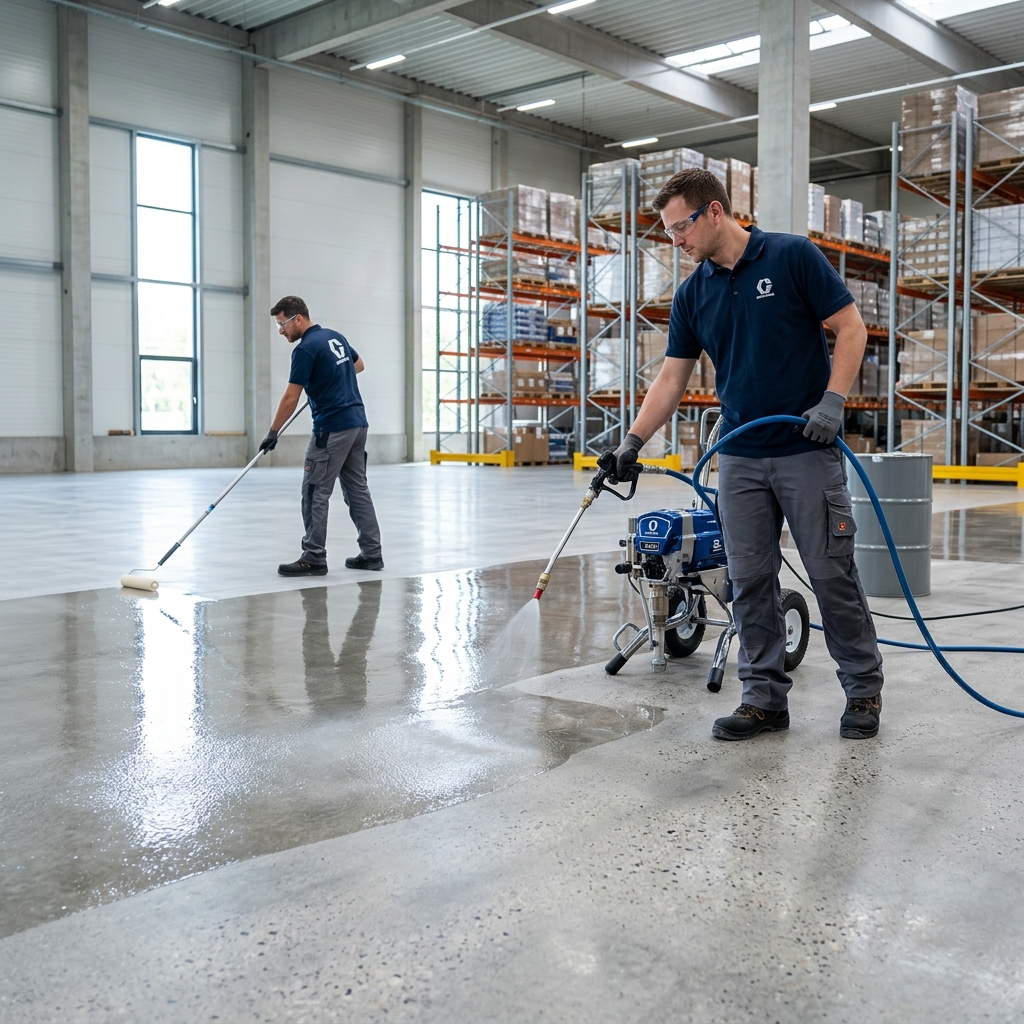
Liquid densifiers — also called chemical hardeners — are water-based solutions of sodium silicate, potassium silicate, lithium silicate, or magnesium fluorosilicate. They are applied to cured concrete surfaces (existing floors or new floors after curing is complete) where they penetrate and react with free calcium hydroxide in the concrete pores to form insoluble calcium silicate hydrate (CSH) — the same binder that gives concrete its strength.
The reaction fills pores and densifies the surface from within, reducing dusting and improving abrasion resistance. Liquid densifiers do not change the floor's appearance significantly — they can leave a slightly matte finish — and they do not create a surface film, so there is nothing to peel or wear off. This is a major advantage over sealers.
Lithium silicate densifiers have become the industry standard because they penetrate deeper (up to 3–5 mm), react more completely, and are safer to handle than sodium or potassium silicates. For an existing dusty warehouse floor, I recommend a two-coat application of lithium silicate densifier, followed by burnishing with a heavy-duty floor scrubber fitted with diamond-impregnated pads. The result is a dense, polished-like surface that resists dusting and is easy to clean.
Floor Sealers
Floor sealers are surface-applied coatings that form a protective film over the concrete. They include acrylics, epoxies, polyurethanes, and polyaspartics. Unlike densifiers, which harden the concrete itself, sealers create a separate layer that takes the wear. Sealers are effective for dust proofing but require periodic renewal — typically every 1–3 years for acrylics and 3–5 years for epoxies and polyurethanes.
The choice between a densifier and a sealer depends on the condition of the floor and the performance requirements. For a new, well-finished concrete floor, a densifier alone is often sufficient to prevent dusting and provide a durable surface. For an old, soft, or damaged floor, a densifier can help, but a sealer or coating may be needed to build a sufficiently thick and tough wearing surface.
Selection Guide by Application
New warehouse floor (heavy forklift traffic): Dry shake hardener + lithium densifier + topical sealer. The shake provides bulk abrasion resistance, the densifier hardens the paste, and the sealer protects against oil and chemical spills.
Existing dusty garage or workshop: Grind the surface lightly to open the pores, apply two coats of lithium densifier, and burnish. This is a low-cost, fast solution that eliminates dusting permanently.
Showroom or retail floor: Densifier followed by polished concrete finish. No topical coating — the floor is maintained by periodic burnishing and re-application of densifier as needed.
Food processing area: Densifier with a seamless epoxy or polyurethane coating. The coating provides chemical resistance and easy cleaning; the densifier ensures any damage to the coating does not immediately lead to dusting.
How long does a liquid densifier take to dry?
Most liquid densifiers dry to the touch in 1–4 hours depending on temperature and humidity. The chemical reaction continues for 48–72 hours after application. Do not wash the floor with water during this period.
Can I apply a densifier over an existing coating?
No. The densifier must penetrate the concrete pores to work. Existing coatings, sealers, or curing compounds must be removed by grinding or shot-blasting before applying a densifier.
Is floor hardening necessary if I plan to apply epoxy flooring?
Ideally, yes. A densified substrate provides a stronger, less porous surface for the epoxy to bond to. However, the densifier must be compatible with the epoxy — some densifiers create a surface that is too smooth for good adhesion. Check with the epoxy manufacturer.