India's construction industry is undergoing a profound shift. With the government pushing for sustainable infrastructure, developers increasingly pursuing green building certifications, and homeowners becoming conscious of indoor air quality and environmental impact, the demand for green construction chemicals has never been higher. But what exactly makes a construction chemical green? Which products deliver genuine sustainability benefits without compromising performance? And how can builders and contractors navigate the growing range of eco-friendly options available in the Indian market? This comprehensive guide answers these questions and provides a practical roadmap for incorporating sustainable construction chemicals into your projects.
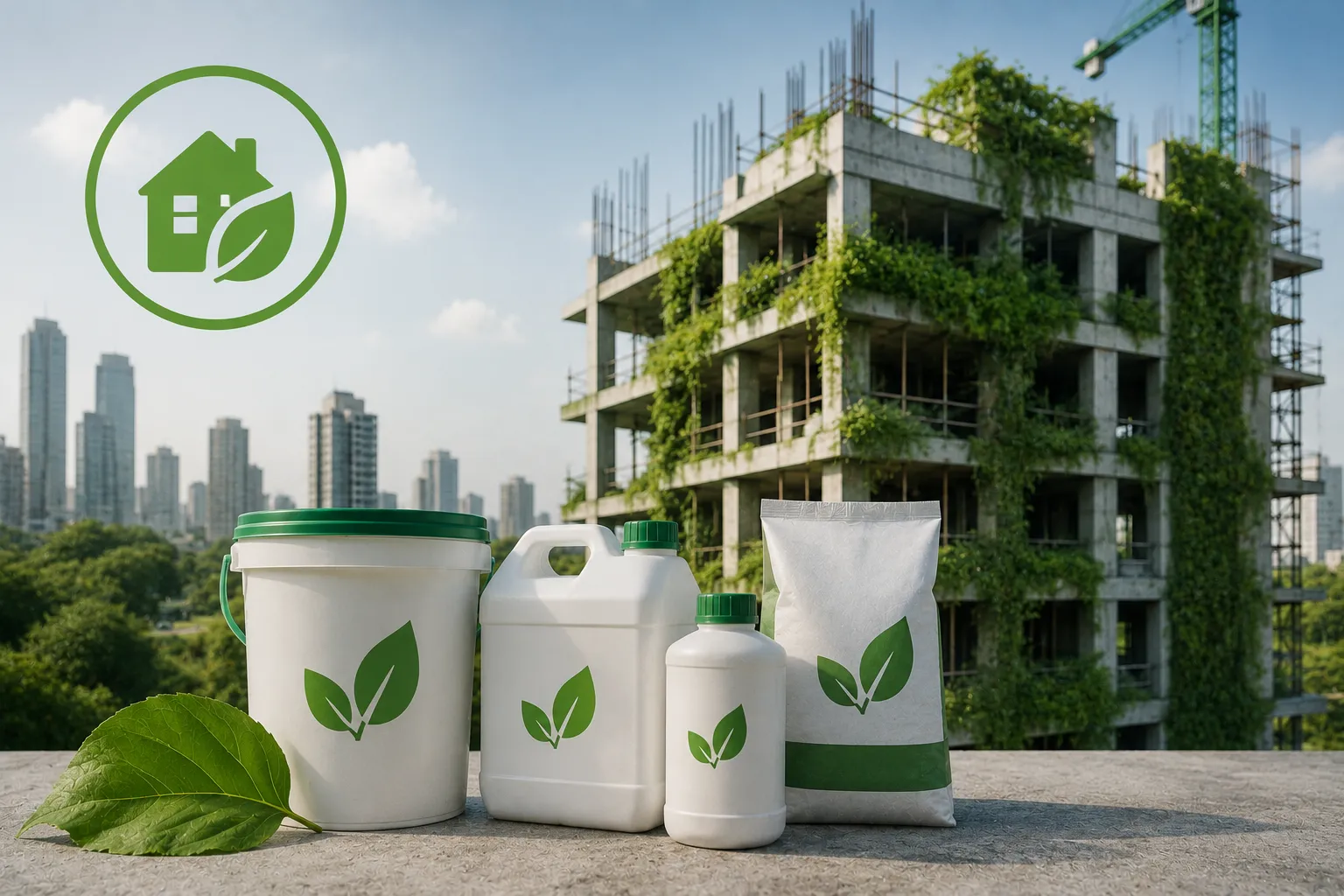
What Makes a Construction Chemical Green?
A construction chemical earns the green label through a combination of factors. Low or zero volatile organic compound (VOC) content is the most widely recognised criterion — VOCs are solvents that evaporate during application and curing, contributing to smog formation and posing health risks to applicators and building occupants. Absence of hazardous substances such as heavy metals (lead, chromium, mercury), phthalates, and aromatic hydrocarbons is another key requirement. Sustainable manufacturing processes that reduce energy consumption, water usage, and waste generation also qualify a product as green. Bio-based content — using raw materials derived from renewable sources such as castor oil, soybean oil, or corn starch instead of petroleum — is increasingly common in modern formulations. Finally, the product's contribution to building sustainability matters most: a waterproofing membrane that lasts 25 years instead of 5 eliminates four cycles of removal and reapplication, saving material, transport, labour, and landfill waste. Longevity is the most sustainable attribute any construction chemical can have.
Green Building Certifications in India
India has three major green building rating systems that influence construction chemical selection. The Indian Green Building Council (IGBC) rating system is the most widely adopted, with over 5,000 registered projects covering more than 7 billion sq ft. IGBC awards points for using low-VOC materials, regional materials, and products with environmental product declarations. The Green Rating for Integrated Habitat Assessment (GRIHA) is the national rating system developed by TERI and adopted by the Government of India. GRIHA emphasises passive design, water efficiency, and waste management, and rewards the use of eco-friendly construction materials including low-VOC paints, adhesives, and sealants. LEED India (Leadership in Energy and Environmental Design), administered by the USGBC through the GBCI, follows similar criteria to the global LEED standard with adaptations for Indian conditions. LEED v4 sets strict VOC limits for interior adhesives, sealants, paints, coatings, and flooring systems. All three rating systems require third-party documentation of VOC content and material sustainability claims. Builders pursuing certification should request VOC test data and material safety data sheets from their chemical suppliers early in the design process.
Low-VOC Coatings and Sealants
Paints, coatings, and sealants are the largest source of VOCs in building construction. Traditional solvent-borne epoxy and polyurethane products can contain 400–600 g/L of VOCs. Modern waterborne alternatives have transformed this landscape. Waterborne epoxy systems now achieve VOC levels below 100 g/L, with zero-VOC formulations reaching under 5 g/L. Acrylic elastomeric roof coatings, widely used for terrace waterproofing, are available in waterborne formulations with VOC content as low as 20 g/L while delivering elongation of 300–500% and tensile strength above 1.5 MPa. For interior applications such as hospital floors, school classrooms, and office spaces, low-VOC epoxy and polyurethane coatings are now the standard specification for any project targeting green certification. Sealants have followed the same trajectory — hybrid polymer and silicone sealants now offer zero-VOC formulations that meet the strictest international standards. When specifying coatings for a green building project, always request the VOC content in grams per litre as tested per ASTM D2369 or IS 1445, and verify compliance with the applicable rating system's limits.
Eco-Friendly Waterproofing Solutions
Waterproofing is essential for building durability, but conventional systems often carry a heavy environmental burden — solvent-based primers, bituminous membranes with high embodied energy, and single-use plastic packaging. Green alternatives are readily available and perform equal to or better than conventional systems. Cementitious crystalline waterproofing is one of the most sustainable options. It reacts with free lime and moisture in the concrete to form insoluble crystals that block capillary pores permanently. It contains no solvents, generates no waste, and lasts as long as the concrete itself — potentially 100 years. For below-grade structures, tunnels, and water-retaining structures, crystalline systems eliminate the need for external waterproofing membranes with their associated excavation, disposal, and replacement cycles. Liquid-applied polyurethane membranes with bio-based content derived from castor oil or soybean oil offer another green pathway. These bio-PU membranes provide the same high elongation (400–800%) and tensile strength as petroleum-based PU but with a significantly lower carbon footprint. Recycled rubber membranes made from post-consumer tyre waste are also gaining traction in India as a sustainable sheet membrane option. For a typical residential terrace project, switching from a conventional bituminous system to a crystalline or bio-PU system can reduce the waterproofing carbon footprint by 40–60%.
Sustainable Concrete Admixtures
Concrete contributes roughly 8% of global CO2 emissions, primarily from cement production. Construction chemicals can significantly reduce this impact. High-range water reducers (superplasticizers), particularly those based on polycarboxylate ether (PCE) technology, allow concrete to achieve design strength with 15–30% less cement. PCE superplasticizers can reduce water content by up to 40% while maintaining workability, enabling high-performance concrete with a lower clinker factor. Supplementary cementitious materials such as fly ash, ground granulated blast furnace slag, and silica fume further reduce cement demand, and chemical activators can improve the reactivity of these alternatives. Corrosion inhibitors, shrinkage-reducing admixtures, and durability-enhancing admixtures extend the service life of concrete structures, reducing the need for premature replacement. In a typical high-rise building, optimised admixture selection can reduce the concrete carbon footprint by 20–30% without any increase in material cost. Every tonne of cement saved through admixture optimisation is roughly 0.9 tonnes of CO2 that never enters the atmosphere.
Bio-Based Construction Chemicals
Bio-based construction chemicals are formulated using renewable raw materials instead of petroleum-derived feedstocks. The most common bio-based products in the Indian market include bio-polyurethanes derived from castor oil, bio-epoxies using plant-based curing agents, and bio-acrylics made from renewable monomers. Castor oil-based polyurethanes have been particularly successful because castor is a non-edible oilseed crop widely grown in India, supporting domestic agriculture while reducing dependence on imported crude oil derivatives. Bio-PU membranes match or exceed the performance of petroleum-based PU in terms of elongation, tensile strength, and UV resistance, with the added benefit of a 20–30% lower carbon footprint. Bio-based mould release agents for precast concrete, formulated with vegetable oils instead of mineral oils, are increasingly specified for green building projects. Grouting additives derived from renewable sources offer similar performance to synthetic alternatives. The key consideration is to verify technical data sheet claims — a well-formulated bio-based product should carry the same 10–25 year warranty as its conventional counterpart.
Benefits for Builders and Developers
Adopting green construction chemicals offers multiple benefits beyond environmental responsibility. Green certification (IGBC, GRIHA, or LEED) increases property value by 5–15% and reduces time to sale or lease. Low-VOC materials improve indoor air quality, leading to healthier occupants and reduced liability — particularly important for healthcare, education, and residential projects. Many green chemical formulations also offer superior performance: waterborne epoxies often cure faster than solvent-borne versions due to optimised cross-linking chemistry, reducing project timelines. The material cost premium for green formulations is typically 10–20%, but the overall project cost impact is negligible — often less than 0.5% of total construction cost. When factoring in certification points, health benefits, occupant productivity gains, and marketing advantages, the investment is strongly positive. Indian developers who have adopted green building practices report faster sales, higher tenant retention, and premium rental rates of 10–25% compared to conventional buildings.
Market Trends in India
The Indian green construction chemicals market is growing at 15–20% annually, driven by several factors. The Government of India's commitment to 10 billion sq ft of green building space by 2030 under the Green Building Mission. Major developers including DLF, Godrej Properties, Brigade Group, and Sobha Ltd have committed to 100% green certified projects. The CSR mandate under the Companies Act has pushed many corporations to adopt sustainable building practices for their offices and manufacturing facilities. Urbanisation and the resulting construction boom in Tier 2 and Tier 3 cities is bringing green building awareness to new markets. The COVID-19 pandemic has heightened awareness of indoor air quality, driving demand for low-VOC and zero-VOC products in residential and commercial projects. International clients leasing office space in India increasingly mandate LEED or IGBC certification as a condition of lease. As the market matures, price premiums for green chemicals are narrowing, and availability across India is improving. Sterling Technotrade is at the forefront of this transition, offering a comprehensive range of green construction chemicals under our Techno Builders Solutions brand, with VOC data, environmental product declarations, and technical support for certification documentation.
Are green construction chemicals more expensive than conventional ones?
The material cost premium is typically 10–20%, but the overall project cost impact is less than 0.5% of total construction cost. When factoring in certification points, health benefits, occupant productivity gains, and marketing advantages, the return on investment is strongly positive.
How do I verify that a construction chemical is genuinely green?
Request third-party VOC test reports (ASTM D2369 or IS 1445), environmental product declarations (EPDs), and bio-based content certification. Reputable manufacturers provide this documentation. For LEED/IGBC projects, ensure the product meets the specific VOC limits in the applicable credit criteria.
Can I use green chemicals for retrofit and renovation projects?
Yes. Many green products are specifically designed for retrofit applications — low-VOC coatings for interior repainting, crystalline waterproofing for basement remediation, and bio-based injection grouts for crack repair. These can be applied in occupied buildings with minimal disruption and without compromising indoor air quality.