Every summer, as temperatures in Delhi, Jaipur, and Ahmedabad cross 45°C, the question comes up again: do heat reflective roof coatings actually work, or are they just another paint that promises more than it delivers? The short answer is yes, they work — when you use the right product and apply it correctly. But there is a lot of misinformation in the market. Low-quality "cool roof" paints with no technical backing are sold at every hardware shop, and homeowners apply them expecting a 10°C drop in room temperature. When that does not happen, they conclude that reflective coatings are a gimmick.
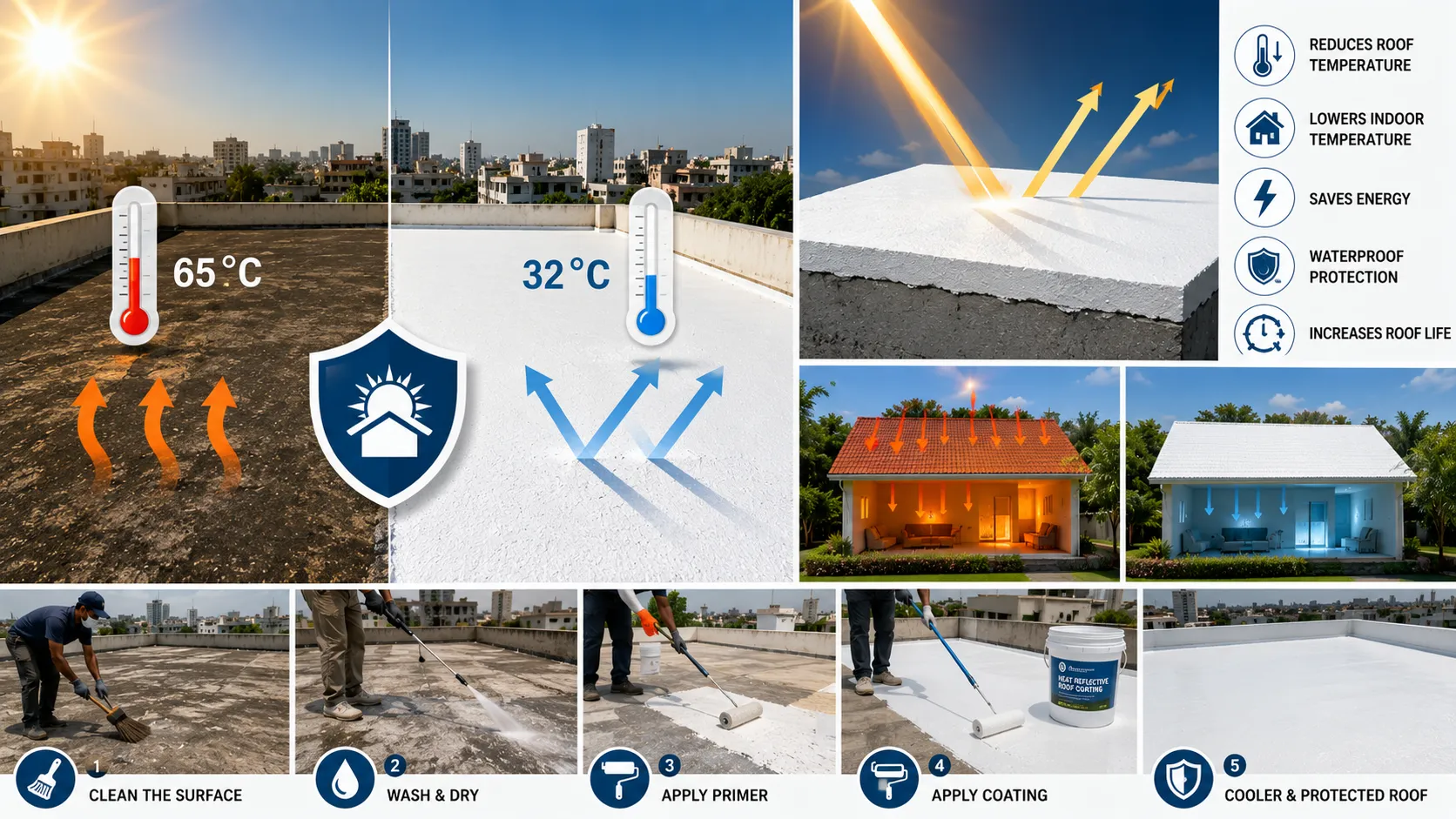
This article separates fact from marketing. We will look at the science of cool roof technology, the different types of reflective coatings available in India, real temperature reduction data from Indian cities, energy savings you can realistically expect, application guidelines, costs, and how reflective coatings compare with other roof cooling methods like insulation, whitewashing, and terrace gardens.
How Heat Reflective Coatings Work
A heat reflective roof coating — also called a cool roof coating — works through two physical properties: solar reflectance and thermal emittance. Solar reflectance is the fraction of incoming solar radiation that the surface reflects back into the atmosphere. A standard grey cement roof has a solar reflectance of about 0.2 to 0.3, meaning it absorbs 70% to 80% of the sun's energy and converts it into heat. A white reflective coating can achieve a solar reflectance of 0.7 to 0.85, reflecting 70% to 85% of solar radiation away from the building.
Thermal emittance is the surface's ability to emit the heat it has absorbed as infrared radiation. Most building materials naturally have high thermal emittance (0.85 to 0.95), so the key variable in cool roof performance is solar reflectance. The higher the solar reflectance, the less heat enters the building through the roof.
The Indian Standard IS 16609:2017 specifies the test methods and minimum performance requirements for cool roof materials. A product must have a solar reflectance of at least 0.5 and a thermal emittance of at least 0.75 to qualify as a cool roof coating under this standard. Always check for IS 16609 compliance when purchasing — many products claiming to be "heat reflective" do not meet these minimum requirements.
The effectiveness of a reflective coating depends on the roof type. On a reinforced cement concrete (RCC) roof slab, the coating reduces the surface temperature, which in turn reduces the heat conducted through the slab into the room below. On a metal sheet roof, the effect is more dramatic because metal has low thermal mass and conducts heat rapidly. In both cases, the coating works best when combined with some form of insulation on the roof underside or in the ceiling.
Types of Reflective Roof Coatings
The Indian market offers several categories of heat reflective roof coatings, each with different performance characteristics and price points.
Acrylic reflective coatings are water-based, easy to apply, and the most affordable option. They contain titanium dioxide and other reflective pigments that give them a white or light colour with high solar reflectance. Acrylic coatings are suitable for concrete roofs, asbestos cement sheets, and metal roofs. They dry quickly and can be applied by brush or roller. The main limitation is durability — acrylic coatings typically last 2 to 3 years before they need recoating because they chalk and erode under UV exposure. Cost: Rs 40 to Rs 70 per sq ft per coat.
Elastomeric reflective coatings are acrylic-based but with added elastomeric polymers that give the dried film rubber-like flexibility. They can bridge hairline cracks (up to 0.5 mm) and accommodate thermal movement without cracking. Elastomeric coatings offer better durability than standard acrylics — 4 to 6 years — and provide basic waterproofing in addition to heat reflection. They are the most popular choice for residential roof cooling in India. Cost: Rs 60 to Rs 110 per sq ft per coat.
Polyurethane-based reflective coatings are two-component systems that form a tough, abrasion-resistant film with excellent UV stability. They offer the best durability of any reflective coating — 8 to 12 years — and superior adhesion to concrete and metal. PU coatings are also highly waterproof and can serve as a combined waterproofing and heat reflective layer. However, they require careful mixing and application and are more expensive. Cost: Rs 120 to Rs 200 per sq ft for a two-coat system.
Ceramic-infused coatings contain hollow ceramic microspheres that increase the thermal resistance of the coating layer. The ceramic spheres create a barrier that reduces heat conduction through the coating itself. Some manufacturers claim dramatic temperature reductions with ceramic coatings, but independent testing shows that the ceramic additive provides only a marginal improvement over high-quality acrylic or elastomeric coatings. The primary benefit is real, but it is often overstated in marketing. Cost: Rs 80 to Rs 150 per sq ft.
Lime-based reflective coatings (chuna) are the traditional Indian approach. A fresh coat of whitewash or lime plaster reflects a significant amount of solar radiation — about 50% to 60%. The cost is negligible (Rs 5 to Rs 10 per sq ft), but the coating needs reapplication every monsoon season because the lime is washed away by rain. For a low-cost, short-term solution, lime whitewash remains a viable option.
Temperature Reduction Data for Indian Cities
The actual temperature reduction achieved by a reflective roof coating depends on the ambient conditions, the roof construction, and the coating's solar reflectance. Based on field studies conducted by Indian research institutions and our own project data from installations across Delhi NCR, here are realistic figures.
On a typical RCC roof slab (150 mm thick, no insulation) in Delhi during peak summer (ambient 42°C, solar radiation 900 W/m²), an untreated grey cement roof reaches a surface temperature of 65°C to 70°C. After applying a white elastomeric reflective coating with solar reflectance of 0.8, the surface temperature drops to 45°C to 48°C — a reduction of 18°C to 22°C on the roof surface. The ceiling temperature (underside of the slab) drops by 4°C to 7°C, and the room temperature drops by 2°C to 4°C depending on ventilation and wall insulation.
In a study conducted by the Central Building Research Institute (CBRI) in Roorkee, buildings with cool roof coatings showed an average indoor temperature reduction of 3.5°C compared to identical buildings without coating. The effect was more pronounced on the top floor (where the room is directly below the roof) than on lower floors. In cities like Ahmedabad and Jaipur, where summer temperatures are extreme and solar radiation is intense, the cooling effect is at the higher end of this range.
For metal sheet roofs — common in industrial sheds, warehouses, and factory buildings — the temperature reduction is even more dramatic. An untreated galvanised iron sheet roof can reach 75°C to 80°C in direct sun. A white reflective coating brings this down to 45°C to 50°C, which translates to a 10°C to 15°C reduction in the air temperature inside the building.
Energy Saving Potential
The primary benefit of a cool roof coating for most homeowners is reduced cooling energy consumption. In an air-conditioned building, every degree of temperature reduction in the room translates to roughly 5% to 8% savings in air conditioning electricity consumption. So a 3°C temperature reduction on the top floor can reduce AC electricity bills by 15% to 24% during the summer months.
For a typical 1,500 sq ft home in Delhi with two 1.5-ton split AC units running 10 hours per day during summer (April to September), the monthly AC electricity bill is roughly Rs 6,000 to Rs 8,000. A 15% reduction saves Rs 900 to Rs 1,200 per month. Over the six-month cooling season, the annual saving is Rs 5,400 to Rs 7,200. A good quality elastomeric cool roof coating for a 1,500 sq ft roof slab costs roughly Rs 12,000 to Rs 18,000 (including labour), giving a payback period of 2 to 3 years. After that, the savings are pure benefit.
For non-air-conditioned buildings, the benefit is improved thermal comfort. A 3°C to 4°C reduction in indoor temperature during peak summer makes the difference between a space that is barely habitable and one that is comfortable with a ceiling fan. In schools, hospitals, and community buildings without air conditioning, cool roof coatings provide a significant improvement in comfort at a fraction of the cost of installing AC systems.
Application Over Existing Waterproofing
A common question is whether a heat reflective coating can be applied over an existing waterproofing membrane. The answer depends on the type of waterproofing. Over cementitious waterproofing or polymer-modified renders, a reflective coating can be applied directly after cleaning and priming. Over liquid-applied PU or acrylic waterproofing, compatibility depends on the specific products — some reflective coatings will not bond to PU membranes. Over bituminous (torch-on) waterproofing, direct application of a reflective coating is not recommended because the solvents in the coating can soften the bitumen, and the black colour of the bitumen will absorb heat regardless of what is applied on top.
If you have a dark-coloured waterproofing membrane and want to add heat reflection, the best approach is to apply a compatible primer and then a PU-based reflective coating that is specifically designed for use over bituminous surfaces. Alternatively, consider applying a cementitious screed over the waterproofing layer and then coating the screed with the reflective paint.
The surface preparation for reflective coatings follows the same principles as for any roof coating. The surface must be clean, dry, and free of dust, oil, and loose particles. Cracks wider than 0.5 mm should be filled with a flexible filler or sealant. Apply a primer if recommended by the manufacturer — especially on porous concrete surfaces. Apply the coating in two coats at right angles to each other, following the recommended coverage rate (typically 8 to 12 sq ft per litre per coat for acrylic coatings). Allow 4 to 6 hours between coats depending on temperature and humidity.
White vs Coloured Reflective Coatings
White is the most effective colour for heat reflection because it reflects all wavelengths of visible light. A white coating with titanium dioxide pigment can achieve a solar reflectance of 0.8 or higher. Pastel colours — light blue, light green, beige — achieve a solar reflectance of 0.5 to 0.7, depending on the shade. Dark colours — grey, red, brown — reflect only 0.2 to 0.4 of solar radiation and are not considered cool roof coatings regardless of the product claims.
Some manufacturers offer "cool coloured" coatings that use infrared-reflective pigments. These pigments reflect the infrared portion of sunlight (which carries about 50% of the sun's heat energy) while absorbing visible light to produce a dark colour. A cool red coating, for example, can have a solar reflectance of 0.5 while appearing red to the eye. These products are useful when aesthetics require a dark colour but heat reflection is still desired. However, they cost more and are not widely available in the Indian market.
For most residential and commercial buildings in India, white is the practical choice. It delivers the highest performance at the lowest cost. If glare from a white roof is a concern — for example, on a low-rise building where the roof is visible from upper floors of adjacent buildings — a light grey or off-white colour provides a good compromise between aesthetics and performance.
Durability and Lifespan
The lifespan of a reflective roof coating depends on the product type, local climate, and maintenance. Acrylic coatings last 2 to 3 years in Indian conditions. UV radiation from the intense Indian sun breaks down the acrylic polymer, causing chalking and erosion. The coating gradually loses its reflective performance as the surface roughens and dirt accumulates. Elastomeric coatings last 4 to 6 years because the higher polymer content provides better UV resistance.
Polyurethane-based reflective coatings are the most durable, lasting 8 to 12 years. They resist UV degradation, do not chalk, and maintain their reflective properties over time. The higher initial cost is offset by the longer service life and reduced maintenance.
Regardless of the coating type, dirt accumulation reduces reflectivity over time. A coating that starts with a solar reflectance of 0.8 can drop to 0.5 or 0.6 after one year without cleaning. An annual wash with water and a mild detergent — or a good monsoon rain — restores most of the lost reflectivity. In dusty Indian cities like Delhi, Jaipur, and Ahmedabad, an annual cleaning is essential to maintain the coating's performance. If cleaning is not practical, a coating with self-cleaning or photocatalytic properties (containing titanium dioxide that breaks down organic dirt in sunlight) can reduce the maintenance burden.
Cost Per Square Foot in India
Here are realistic all-in costs (material + labour) for application of heat reflective roof coatings in the Delhi NCR region. Prices vary by city and applicator:
Lime whitewash (chuna): Rs 5 to Rs 10 per sq ft. Acrylic reflective coating (two coats): Rs 40 to Rs 70 per sq ft. Elastomeric reflective coating (two coats): Rs 60 to Rs 110 per sq ft. Ceramic-infused coating (two coats): Rs 80 to Rs 150 per sq ft. PU-based reflective coating (two coats): Rs 120 to Rs 200 per sq ft.
For a 1,000 sq ft roof terrace, a good quality elastomeric system costs Rs 60,000 to Rs 1,10,000. Over a 4-year lifespan, this works out to Rs 15,000 to Rs 27,500 per year — less than the annual electricity savings for an AC-cooled home. The economics are even more favourable for larger roof areas because the application cost per sq ft decreases with scale.
Comparison with Other Cooling Methods
Reflective coatings are not the only way to cool a roof. Here is how they compare with other common methods used in India:
Roof insulation (extruded polystyrene or PUF panels). Insulation provides better thermal resistance (R-value) than reflective coatings, reducing heat flow through the roof by 60% to 80%. However, insulation is more expensive (Rs 200 to Rs 400 per sq ft installed) and requires a protective screed above it. Best for new buildings where the roof structure can be designed to accommodate the insulation thickness. Reflective coatings are a cost-effective retrofit alternative.
Terrace garden / green roof. A layer of soil and plants provides excellent insulation and cooling through evapotranspiration. The surface temperature of a green roof can be 20°C to 30°C lower than a bare roof in summer. However, green roofs require structural reinforcement to support the additional load (100 to 250 kg/m² when saturated), a drainage layer, waterproofing, and ongoing maintenance. Cost is Rs 300 to Rs 600 per sq ft. Best for high-end residential or commercial buildings where budget and structural capacity allow.
Modular roof cooling systems (sprinklers / water film). Spraying water on the roof surface cools it through evaporative cooling. These systems are inexpensive to install (Rs 15,000 to Rs 30,000 for a typical home) but consume significant water — a concern in water-scarce Indian cities. They also require pumps, filters, and maintenance. Effective for immediate temperature reduction but not a permanent solution.
False ceiling with insulation. A false ceiling with mineral wool or glass wool insulation reduces heat transfer from the roof to the occupied space. The cost is Rs 100 to Rs 200 per sq ft. The benefit is that it also improves acoustics and hides roof services. However, a false ceiling does nothing to reduce the roof slab temperature, which contributes to the urban heat island effect. Combining a false ceiling with a reflective roof coating gives the best of both worlds.
For most Indian homeowners looking for a practical, affordable, and effective way to reduce summer heat, an elastomeric or PU-based reflective coating applied directly to the roof slab is the best option. It requires no structural changes, has a reasonable upfront cost, pays back its investment in 2 to 3 years through reduced electricity bills, and also provides waterproofing benefits. If the budget allows, combining the reflective coating with a false ceiling with insulation will give the best thermal comfort.