If there is one component of a post-tensioned bridge that is most often underestimated — and most often responsible for premature failure — it is the grout inside the tendon ducts. Post-tensioning (PT) grouting is the process of filling the voids around prestressing steel strands with a cementitious grout after the strands have been tensioned. It sounds simple, but getting it right requires careful material selection, precise mixing, proper injection technique, and rigorous quality control. In Indian bridge construction, where projects under MORTH and various state PWDs are executed at tremendous pace, PT grouting is frequently rushed, and the consequences are costly.
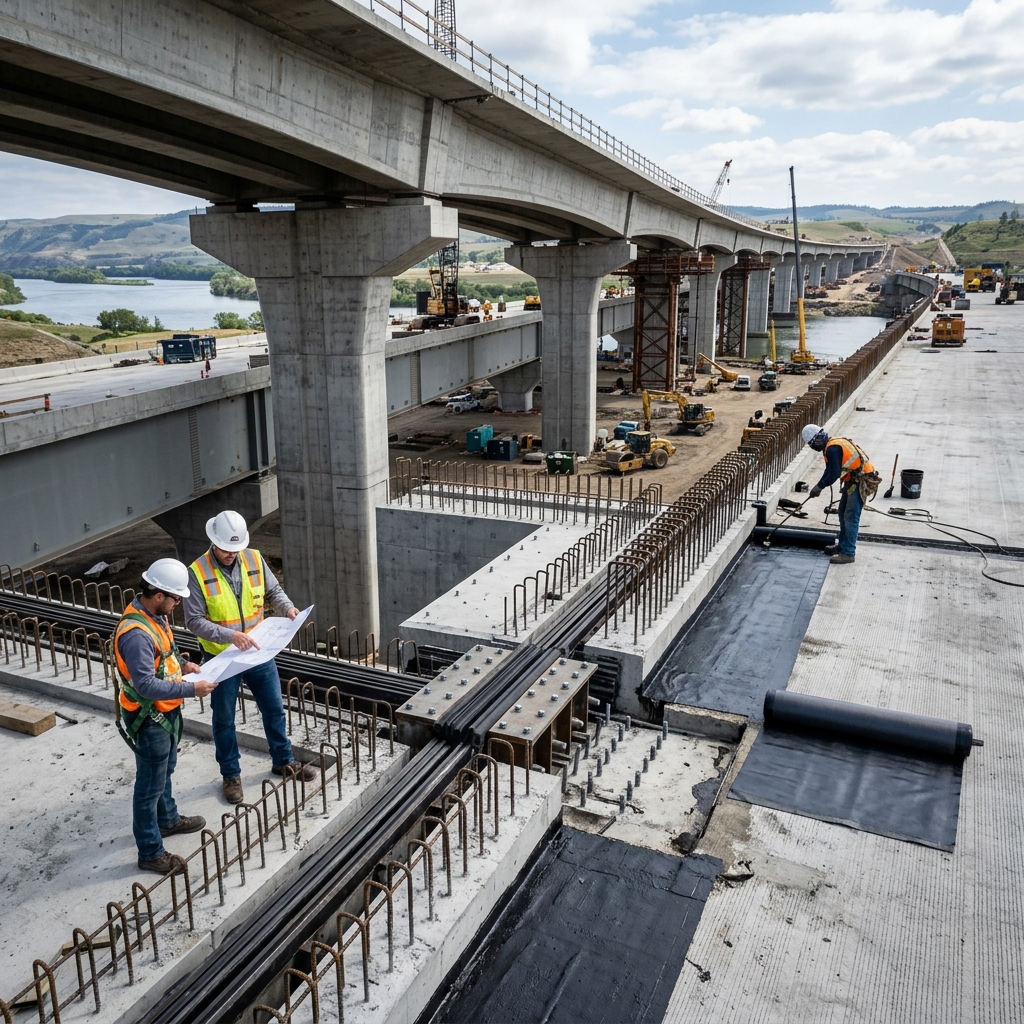
This article explains why PT grouting matters, what materials and methods are used, what quality standards apply in India, and how to avoid the defects that lead to tendon corrosion and structural failure.
What Is Post-Tensioning?
Post-tensioning is a method of prestressing concrete in which high-strength steel strands or bars are tensioned after the concrete has hardened. The strands are housed inside ducts (metal or plastic corrugated sheathing) that are cast into the concrete. Once the concrete reaches sufficient strength, the strands are stressed using hydraulic jacks, and the ends are anchored. The ducts are then filled with grout to protect the strands from corrosion and to bond them to the surrounding concrete.
Post-tensioning allows longer spans, thinner slabs, and more efficient use of materials than conventional reinforced concrete. In India, post-tensioning is used extensively in flyovers, metro rail viaducts, long-span bridges, and large commercial buildings. The Delhi-Mumbai expressway corridor, the Mumbai Metro, the Bengaluru suburban rail, and hundreds of flyovers under construction across the country all rely on post-tensioned concrete. Each of these structures contains thousands of metres of tendon ducts that must be fully and durably grouted.
The Role of Grouting in PT Systems
Grouting serves two critical functions in a post-tensioned system: corrosion protection and bond transfer.
Corrosion protection. The prestressing strands are under constant high stress (typically 70–80% of their ultimate tensile strength). At this stress level, even minor corrosion can cause stress corrosion cracking and sudden, brittle failure with no prior warning. The grout provides an alkaline environment (pH 12.5–13.5) that passivates the steel surface and prevents corrosion. If the grout is not fully filling the duct, or if it is porous or cracked, water and chlorides can reach the strands and initiate corrosion. This is the single most common cause of PT tendon failure worldwide, and it is almost always attributable to poor grouting.
Bond transfer. The grout bonds the strands to the surrounding concrete, creating a composite section that acts monolithically. Without proper bond, the prestressing force is concentrated at the anchorages rather than being distributed along the member. This leads to higher stresses at the ends and reduced structural efficiency. For external tendons (those outside the concrete section), the grout also provides lateral restraint that prevents the strands from vibrating or moving under load.
Grout Materials for PT Ducts
The grout used for PT ducts is not ordinary cement grout. It must meet specific performance requirements: high fluidity to fill narrow ducts fully, low bleed to avoid water pockets at the top of the duct, controlled expansion to compensate for plastic shrinkage, and sufficient strength to transfer bond stresses. The materials used in PT grouting have evolved significantly over the past two decades.
Ordinary Portland Cement (OPC) 53 Grade is the base material for most PT grouts on Indian sites. It is mixed with water at a low water-to-cement ratio (0.30–0.35) to achieve the required strength and low permeability. However, neat OPC grout at these low w/c ratios is extremely viscous and difficult to pump, and it bleeds significantly. For this reason, neat OPC grout alone is rarely adequate for modern PT work, though it is still used on some smaller projects.
Pre-packaged PT Grouts are factory-blended products that contain cement, fine fillers, superplasticizers, expansion agents, and anti-bleed admixtures in precisely controlled proportions. These grouts are designed to be mixed with a specific quantity of water on site and pumped immediately. They offer consistent performance and are the preferred choice for critical infrastructure projects. Sterling Technotrade's Techno Builders Solutions range includes a pre-packaged PT grout (TBS-PTG) that meets IRC and international (FIB) requirements for fluidity, bleed, expansion, and strength. I have specified this grout on several metro rail projects where consistency across thousands of cubic metres of grout was essential.
Anti-bleed Admixtures are essential additives when site-mixed OPC grout is used. These are viscosity-modifying agents, typically welan gum or diutan gum, that increase the yield stress of the grout and prevent the cement particles from settling. Without these, the grout will bleed 2–5% of its volume, leaving water-filled voids at the top of the duct that become corrosion initiation sites. The anti-bleed admixture should be dosed precisely — too little and the grout bleeds, too much and it becomes too stiff to pump.
Expansion Agents (aluminium powder or calcium sulfoaluminate) are added to compensate for the plastic shrinkage that occurs as the grout settles and hydrates. The expansion should be carefully controlled — typically 2–5% by volume in the plastic state, reducing to 0–2% after hardening. Over-expansion can cause the grout to burst the duct or lift the anchorages.
Mixing and Injection Methods
PT grout must be mixed using a high-shear colloidal mixer, not a simple paddle mixer. The high-shear action ensures complete dispersion of the cement particles and admixtures, producing a homogeneous, stable grout with consistent fluidity. The mixing time should be at least 3 minutes after all materials are added, and the grout temperature should be maintained between 10°C and 30°C during mixing and pumping.
The grout is injected into the duct through a grout inlet at the low end of the duct while air and water are expelled through a vent at the high end. The injection pressure must be controlled — typically 0.5–2.0 MPa for horizontal ducts and up to 3.0 MPa for vertical ducts. Excessive pressure can blow out the duct joints or the anchorages. The pumping rate should be slow enough that the grout flows as a continuous plug without trapping air pockets.
For long tendons (over 50 metres), intermediate vents are required at intervals of 20–30 metres to allow trapped air to escape. The grout should be pumped until the return grout at the vent has the same consistency as the injected grout, indicating that all air and water have been displaced. The vent is then closed, and the injection continues at a reduced pressure to compact the grout. This process, called "bleeding the duct," is critical for achieving full filling.
For very long or vertical tendons, vacuum-assisted grouting is increasingly specified. A vacuum pump is connected to the high end of the duct to draw out air before grouting begins, creating a negative pressure of -0.08 to -0.09 MPa. The grout is then pumped into the evacuated duct, ensuring complete filling without any air voids. Vacuum grouting is the gold standard for critical bridge tendons and is required by IRC specifications for certain applications.
Quality Tests for PT Grout
Every batch of PT grout should be tested before injection to verify that it meets the specification requirements. The most important tests are described below.
Flow Cone Test (ASTM C939 / IS 14277). This is the primary field test for grout fluidity. A standard flow cone (12.7 mm orifice) is filled with grout, and the time for 1.725 litres of grout to flow out is measured. For PT grout, the target flow time is typically 20–35 seconds at the time of injection. Grout that is too thick (flow time > 40 seconds) will not fill narrow ducts fully; grout that is too thin (flow time < 15 seconds) will bleed excessively and may not provide adequate corrosion protection.
Bleed Test (ASTM C940). A 1000 ml graduated cylinder is filled with grout and left undisturbed. The volume of bleed water that collects at the top is measured after 1 hour and 3 hours. For PT grout, the total bleed should not exceed 0.3% by volume, and any bleed water should be reabsorbed within 24 hours. I have seen many Indian site labs skip this test, which is a serious mistake — excessive bleed is the leading indicator of future corrosion problems.
Expansion Test (ASTM C827). This measures the volume change of the grout from the time of mixing to initial set. The expansion should be between 2% and 5% for the first few hours, then stabilize. Negative expansion (shrinkage) is unacceptable because it leaves voids at the top of the duct.
Compressive Strength (ASTM C942 / IS 14277). 50 mm cube specimens are prepared from the grout and tested at 7 days and 28 days. The minimum 28-day compressive strength for PT grout is typically 30 MPa for normal applications and 40 MPa for critical tendons. Higher strength is generally correlated with lower permeability and better corrosion protection.
Common Defects and How to Avoid Them
Despite the availability of good materials and standards, PT grouting defects remain common on Indian projects. The most frequent problems are voids, bleeding, and incomplete filling.
Voids. Air pockets trapped in the duct are the most common grouting defect. They occur when the injection rate is too fast (allowing the grout to flow around air pockets rather than displacing them), when the vents are too far apart, or when the injection pressure is too low. Voids leave the strands exposed to moisture and are almost always where corrosion begins. The solution is to inject slowly, use sufficient vents, and maintain adequate pressure until all air is expelled. Vacuum-assisted grouting eliminates voids entirely.
Bleeding-Induced Voids. When a grout with high bleed is used in a vertical or inclined duct, the bleed water rises to the top and forms a horizontal void under each duct high point. These voids can be centimetres deep and extend over metres of tendon length. They are the reason anti-bleed admixtures are mandatory in modern PT grouting. If the grout bleed exceeds 0.3%, the injection procedure must be adjusted or the grout formulation changed.
Incomplete Filling at Anchorage Ends. The anchorages and trumpet connections are particularly difficult to grout fully because the geometry is complex and air can be trapped in the trumpet. Special venting at the anchorage end and careful injection control are required. I have seen several instances where post-tensioning corrosion was traced directly to incompletely grouted anchorages, leading to tendon failure at the very point where the stress is highest.
Segregation. If the grout is mixed with too much water or pumped at too high a flow rate, the cement particles can settle out, leaving a weaker, more porous grout at the top of the duct. This is especially problematic in long horizontal ducts where the grout must travel 50–100 metres. The solution is to maintain the specified w/c ratio strictly and to use a properly designed anti-bleed admixture that keeps the cement particles in suspension.
PT Grouting Standards in India (IRC and MORTH)
In India, post-tensioning grouting is governed by the Indian Roads Congress (IRC) specifications and the Ministry of Road Transport and Highways (MORTH) guidelines, which are adopted by most state PWDs and metro rail authorities.
IRC 112 (Code of Practice for Concrete Road Bridges) includes specific requirements for PT grouting, including the use of approved grout materials, minimum compressive strength of 30 MPa at 28 days, and maximum bleed of 0.3%. It also requires that all PT ducts be grouted within 14 days of stressing to minimize the time the strands are exposed to potential corrosion.
MORTH Section 1600 (Prestressed Concrete) and MORTH Section 1700 specify the materials, equipment, and procedures for PT grouting in road bridges. They require that the grout be mixed in a high-shear colloidal mixer, that the flow cone time be maintained between 20 and 35 seconds, and that the grout be injected continuously until return grout at the vents matches the incoming grout in consistency.
IRS Concrete Bridge Code (Indian Railway Standards) has similar provisions for railway bridges and metro viaducts, with additional requirements for grout durability under cyclic loading and aggressive environmental conditions.
For the Delhi Metro, Mumbai Metro, and other major urban transit projects, the PT grouting specifications typically go beyond MORTH requirements, adopting FIB (Federation Internationale du Beton) Bulletin 89 guidelines, which are the most comprehensive international standard for PT grouting. These specify anti-bleed grouts, vacuum-assisted injection for all tendons over 40 metres long, and mandatory 100% inspection of completed grouting using non-destructive testing.
Inspection and Testing Protocols
Inspection of PT grouting should include both pre-grouting checks and post-grouting verification. Pre-grouting checks verify that the ducts are clean and dry, that all vents are open and functioning, that the injection equipment is calibrated, and that the grout mix design has been approved by the engineer. The grout temperature, ambient temperature, and relative humidity should be recorded for each injection operation.
During injection, the flow cone time, injection pressure, pumping rate, and grout volume should be recorded continuously. Many modern grouting systems are equipped with automated data loggers that record these parameters and produce a grouting report for each tendon. This report should be submitted to the engineer as part of the quality assurance documentation.
Post-grouting inspection should include visual verification that grout has exited all vents (confirmed by the presence of grout at each vent during injection). For critical tendons, non-destructive testing such as low-frequency ultrasonic pulse echo or impact echo can be used to detect voids in the grout. However, these techniques are not yet widely applied in Indian bridge construction. The most common post-grouting check is simply to monitor the anchorages for signs of corrosion during subsequent inspections — by which time any grouting defect has already begun to cause damage.
I strongly recommend that every bridge project include a post-grouting inspection protocol that specifies which tendons will be tested by NDT methods, what acceptance criteria apply, and what remedial actions will be taken if voids are detected. This protocol should be established during the design stage and included in the contract documents. It costs very little compared to the cost of a tendon failure, which can run into crores for a major bridge.