If you are building or renovating a home in India, one decision you will almost certainly face is how to fix your tiles. The traditional method is cement sand mortar — the age-old mixture your local mason has been using for decades. The newer option is readymade tile adhesive — a factory-produced powder that you just mix with water and apply. Both get the job done, but they are not interchangeable. Each has its strengths and weaknesses, and choosing the wrong one for your specific application can lead to loose tiles, cracked floors, or wasted money.
This article compares tile adhesive and cement sand mortar across all the factors that matter — bond strength, ease of use, cost, drying time, suitability for different tile types, and durability. By the end, you will know exactly which one to use for your project.
What Is Cement Sand Mortar?
Cement sand mortar for tile fixing is a simple mixture of Portland cement, fine sand, and water. The typical ratio is 1 part cement to 4 to 6 parts sand, mixed to a semi-dry or wet consistency depending on the application. The mortar is spread on the floor or wall, and the tile is pressed into it. The cement hydrates and hardens, locking the tile in place. This method has been used in Indian construction for generations, and most masons are very comfortable with it. The materials are cheap and readily available at any local hardware store. The cost per square foot is very low — typically Rs 3 to Rs 8 per sq ft for the mortar alone.
What Is Tile Adhesive?
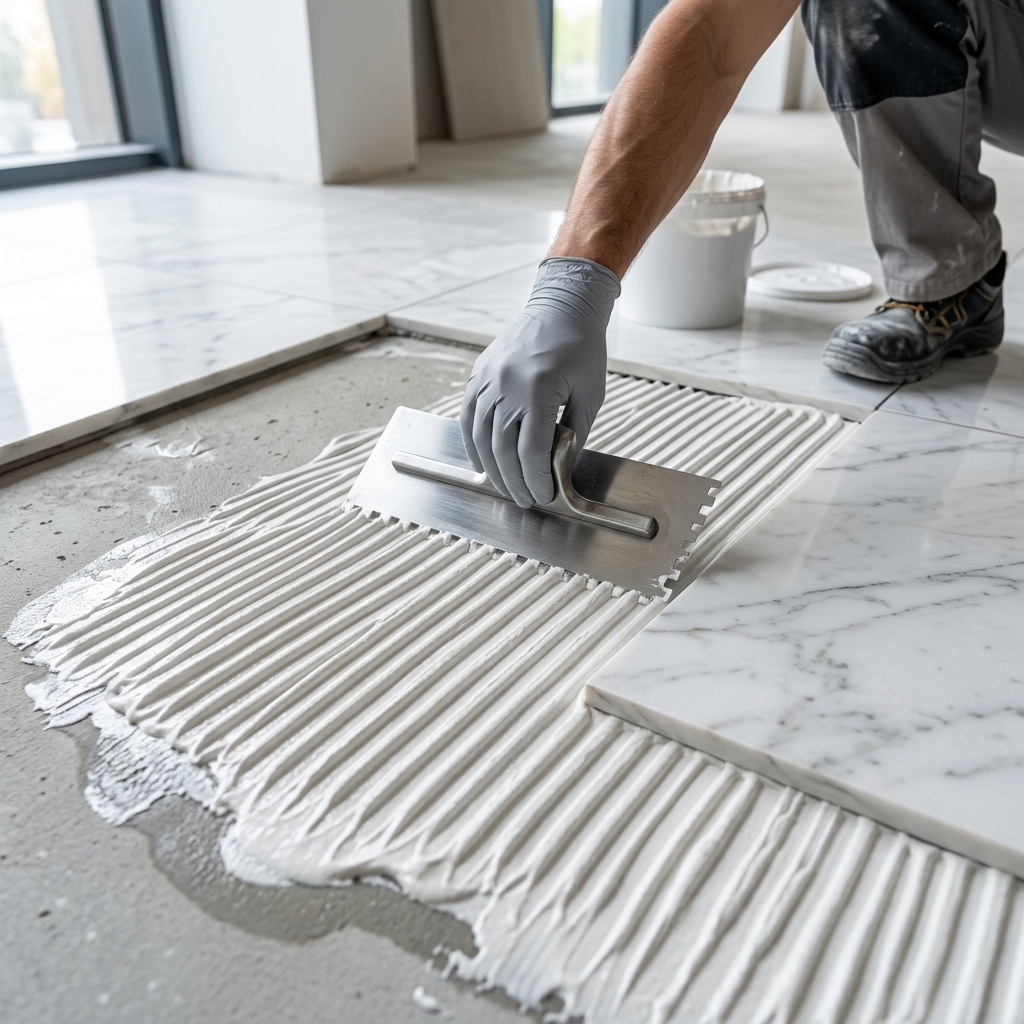
Tile adhesive, also called thin-set mortar or dry-set mortar, is a pre-blended mixture of cement, fine graded sand, and polymer additives. You buy it in 20 kg or 25 kg bags, mix it with clean water to the right consistency, and apply it to the substrate using a notched trowel. The notches create uniform ridges that ensure full coverage when the tile is pressed in. The polymer additives give tile adhesive several advantages over plain cement mortar — higher bond strength, better flexibility, water resistance, and a longer working time. Premium tile adhesives also have anti-slip properties that prevent tiles from sliding down walls after installation.
At Sterling Technotrade, our Technofix tile adhesive range includes products for ceramic tiles, porcelain tiles, large-format tiles, and natural stone, each formulated for specific substrate and tile types.
Bond Strength Comparison
Tile adhesive wins hands down on bond strength. The polymer modifiers in tile adhesive create a chemical bond with both the tile and the substrate, in addition to the mechanical bond. Cement sand mortar relies almost entirely on mechanical bonding — the mortar grips the rough back of the tile and the rough substrate surface. For vitrified tiles, which have very low water absorption and smooth backs, cement sand mortar often fails to create a strong bond. This is why vitrified tiles laid with plain mortar tend to "hollow" or come loose over time. Tile adhesive is specifically formulated to bond with low-absorption tiles and provides significantly higher pull-off strength. For walls, tile adhesive is strongly recommended because gravity works against the bond, and cement mortar on walls has a higher failure rate, especially with larger tiles.
Cost Comparison
Cement sand mortar is cheaper per square foot — there is no getting around that. The raw materials cost Rs 3 to Rs 8 per sq ft. Tile adhesive costs Rs 15 to Rs 35 per sq ft depending on the grade and brand. For a 1,000 sq ft tiling project, using adhesive adds Rs 12,000 to Rs 27,000 to the material cost compared to mortar. However, the total cost is not just the material. Cement mortar requires more labour time because the mortar bed is thicker (15 to 25 mm) and needs more skill to get level. Tile adhesive is applied in a thin layer of 3 to 6 mm, which is faster and requires less labour. The labour savings partially offset the higher material cost. Also, the risk of tile failure is lower with adhesive, which saves you the cost of replacement and repair down the line. For large-format tiles (600x600 mm and above), tile adhesive is not just better — it is the only reliable option.
When to Use Cement Sand Mortar
Cement sand mortar still has its place. For small ceramic tiles (200x200 mm or smaller) on floors with moderate traffic, cement mortar works perfectly well. It has been used for decades in Indian homes for small bathroom floor tiles and standard wall tiles, and it performs adequately when done correctly. For areas where the substrate is very uneven, cement mortar can be applied in a thicker layer to level out the surface. Tile adhesive has a maximum bed thickness of about 10 mm, beyond which it may shrink and crack. For outdoor areas on even ground where cost is the primary concern, cement mortar can be a practical choice for small-format tiles. And for masons who have been using mortar their entire careers, the familiarity factor means they may produce better results with mortar than with an adhesive they have not been trained to use.
When to Use Tile Adhesive
Use tile adhesive for all vitrified tiles, porcelain tiles, and large-format tiles (600x600 mm or larger). These tiles have very low water absorption and need the high bond strength of polymer-modified adhesive. Use it for wall tiling — especially in kitchens and bathrooms — because the superior bond prevents tiles from sliding or falling. Use it for areas exposed to water or moisture, such as bathroom floors, shower walls, and balcony tiles. The polymer additives make the adhesive water-resistant and prevent tile loosening over time. Use it for natural stone like marble and granite, which require a non-staining, white-coloured adhesive. And use it for areas where speed matters, because adhesive application is significantly faster than the traditional mortar bed method.
Installation Process Comparison
With cement sand mortar, the mortar is mixed on site, spread on the floor, and the tile is tapped into place. The mortar bed is 15–25 mm thick. The tiles need to be soaked in water before installation to prevent them from absorbing water from the mortar too quickly. With tile adhesive, the powder is mixed with water to a paste, applied to the substrate with a notched trowel, and the tile is pressed firmly into place. No soaking of tiles is needed. The adhesive bed is only 3–6 mm thick. The notched trowel ensures uniform coverage. The adhesive allows 15–20 minutes of adjustment time after placing the tile, which is enough to make fine adjustments to alignment. Cement mortar starts setting faster and gives less adjustment time.
Durability and Lifespan
When properly installed, both methods can last 15 to 20 years or more with normal usage. However, tile adhesive provides better long-term reliability in demanding conditions. The polymer-modified bond is more resistant to vibration, thermal movement, and moisture. Cement mortar tends to degrade faster in wet areas because the cement can leach out over time. For outdoor tiles exposed to rain and temperature changes, adhesive-based installation lasts significantly longer. For interior dry areas with small tiles, the lifespan difference is negligible.
Conclusion
Tile adhesive is the better choice for most modern tiling applications. It provides stronger bond, faster installation, better water resistance, and works with all tile types, especially large-format and vitrified tiles that are now standard in Indian homes. Cement sand mortar remains a viable option for small-format ceramic tiles on even substrates in dry areas, where cost is a major concern and the mason is experienced. But as tile sizes get larger and vitrified tiles become the norm, tile adhesive is rapidly becoming the default choice across India. The small extra upfront cost is well worth the peace of mind that your tiles will stay firmly in place for decades. For your next tiling project, talk to your contractor about using tile adhesive, especially for walls and large floor tiles. Your future self will thank you when no tiles come loose.
Explore our Technofix tile adhesive range at Sterling Technotrade. If you need help selecting the right adhesive for your tile type, contact our technical team for guidance.