If you own a home in India, chances are you have an overhead or underground water tank. And if that tank is made of RCC, you have probably dealt with leaks, seepage, or algae growth at some point. Water tank waterproofing is not just about stopping leaks — it is about ensuring the water your family drinks, cooks with, and bathes in stays clean and safe. Unlike roof or basement waterproofing, tank waterproofing has an added responsibility: whatever coating you apply must be non-toxic and safe for potable water storage.
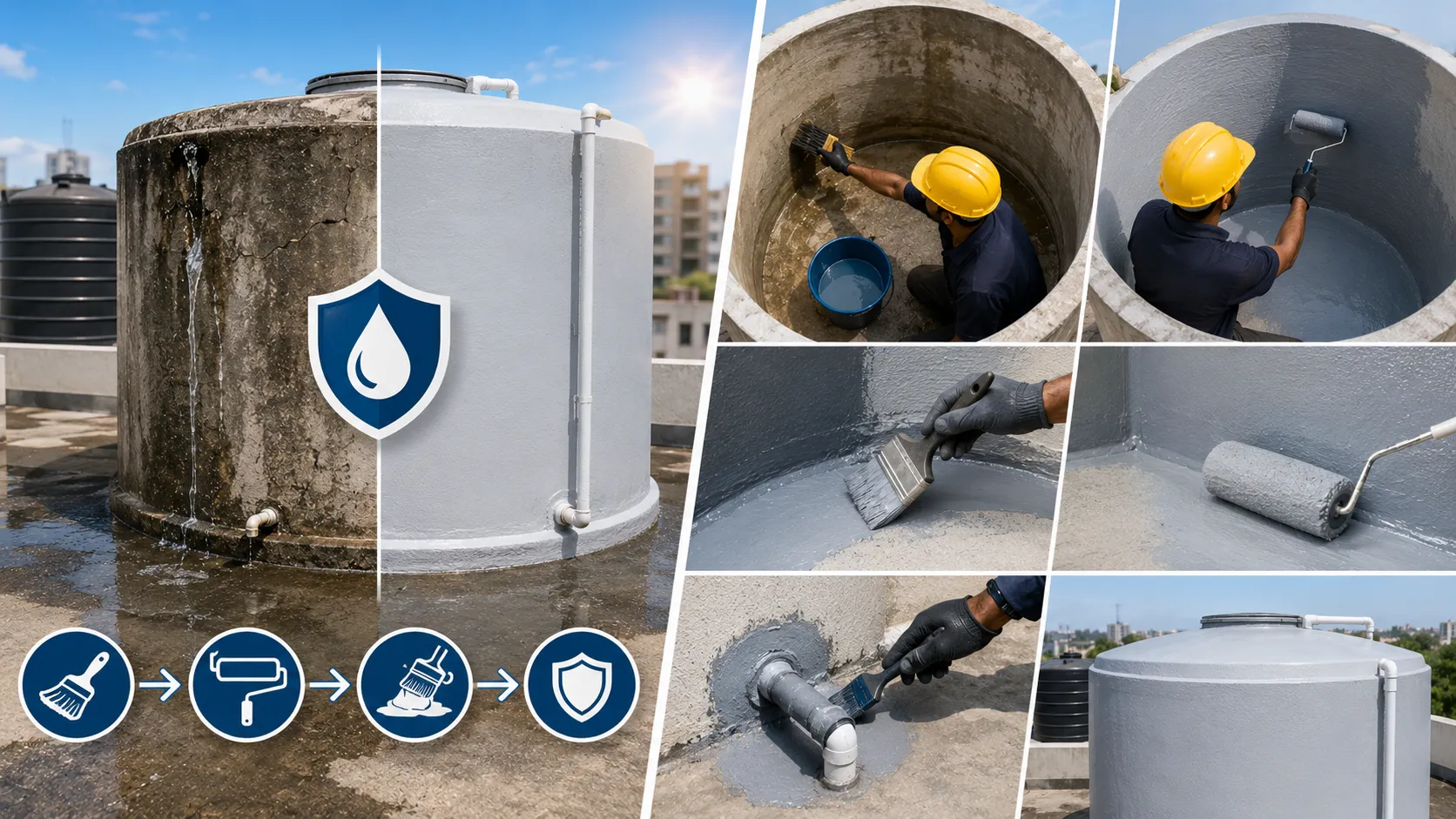
In this guide, I walk you through everything you need to know about waterproofing water tanks in Indian homes — the types of tanks, why they fail, which waterproofing system to use, and a step-by-step application procedure that any good contractor can follow.
Types of Water Tanks in India
Indian homes typically use three types of water storage tanks, and each demands a different waterproofing approach.
RCC (Reinforced Cement Concrete) Tanks: These are the most common in older homes and multi-storey buildings. Built in situ on the terrace or underground, RCC tanks are monolithic structures. Their biggest drawback is porosity — even good-quality concrete lets water seep through over time. Micro-cracks develop from thermal movement, settlement, or curing shrinkage, and once water finds a path, it widens over time. For RCC tanks, the waterproofing system must seal the entire inner surface and bridge any existing cracks.
Plastic (Polyethylene/PVC) Tanks: Widely used in modern homes, plastic tanks are rotomoulded in a single piece and are inherently waterproof. They do not need internal waterproofing. However, the joints where inlet, outlet, and overflow pipes connect are leak-prone. The plastic can also become brittle from prolonged UV exposure — so external protection or shading is recommended. For plastic tanks, waterproofing efforts focus on pipe connections and ensuring the tank base is level and well-supported.
Metal (Mild Steel/Stainless Steel) Tanks: MS tanks are common in apartments and industrial settings. They are prone to corrosion at welded joints and at the waterline. Stainless steel tanks resist corrosion but are expensive. For MS tanks, internal food-grade epoxy coatings are the standard solution. Never use cementitious coatings on metal — they will not bond properly and will crack off.
Why Water Tanks Leak
The most common reasons for water tank leakage in Indian homes are simple but worth understanding before you start any repair.
Poor concrete compaction during construction leaves honeycombing and voids that act as water channels. Inadequate curing causes shrinkage cracks — many RCC tanks develop fine hairline cracks within the first year just from improper curing. Temperature variations in Indian summers cause the tank roof and walls to expand and contract, opening up cracks that were not visible in winter. Settlement or structural movement can create through-cracks in the tank walls or base slab. And in underground tanks, hydrostatic pressure from saturated soil outside forces water through any weak point — this is why underground tank leaks often appear only during the monsoon.
Identifying the exact leak source is not always straightforward. Water may enter at one point and travel laterally along the reinforcement before appearing at a different location. A proper hydrostatic test — filling the tank and marking wet spots after 24–48 hours — is the most reliable way to diagnose.
Cementitious vs Liquid Membranes for Potable Water
When it comes to waterproofing the inside of a drinking water tank, only a handful of systems are suitable. The coating must be non-toxic, should not leach chemicals into the water, must resist continuous water immersion, and should be easy to apply in confined tank interiors.
Cementitious Waterproofing: This is the traditional and most widely used system for RCC water tanks in India. It is a blend of cement, fine aggregates, and chemical additives that reduce permeability and enhance waterproofing. Applied as a slurry coating, it bonds chemically with the concrete substrate, becomes part of the tank wall, and is completely safe for drinking water. Cementitious coatings are breathable — they allow water vapour to escape without blistering — and they work well on damp substrates. Application is straightforward: clean the surface, wet it, apply two coats of slurry with a stiff brush, and keep it moist for curing. The cost is low — roughly Rs 30–50 per square foot including labour for a standard tank.
Liquid Membranes (Food-Grade Epoxy/Polyurethane): These are high-performance coatings that form a seamless, impermeable barrier. Food-grade epoxy coatings are the gold standard for metal tanks and are also excellent for RCC tanks where maximum chemical resistance is needed. They cure to a hard, glossy finish that is easy to clean and does not support bacterial growth. However, the application is more demanding — the surface must be completely dry, and the two components must be mixed accurately. Potable water-grade certification (NSF/ANSI 61 or equivalent) is non-negotiable. Cost is higher at Rs 60–100 per square foot.
Which to choose? For most Indian homes with RCC tanks, cementitious waterproofing is the practical recommendation — it is cheaper, easier to apply, works on damp surfaces, and is proven reliable for decades. Use liquid food-grade epoxy when you have a metal tank, when the existing tank has persistent algae or bacterial issues, or when you want a smoother, cleanable interior finish.
Step-by-Step Waterproofing Application
Here is a practical step-by-step procedure for waterproofing an RCC water tank using a cementitious waterproofing system.
Step 1 — Empty and Clean the Tank: Drain all water. Remove sludge, algae, and loose deposits with a stiff wire brush and water jet. For stubborn organic growth, scrub with a dilute solution of hydrochloric acid (5–10%) and rinse thoroughly with clean water. The surface must be free of oil, grease, and dirt.
Step 2 — Prepare the Surface: Chip out any loose or delaminated concrete using a hammer and chisel. If you find exposed reinforcement, clean the rust off with a wire brush and apply a corrosion-inhibiting primer. Fill all honeycombed areas and major cracks with a quick-setting repair mortar. For cracks wider than 0.5 mm, rout out the crack to a width of 6–10 mm and fill with a non-shrink cementitious grout.
Step 3 — Wet the Surface: Cementitious coatings require a damp substrate for proper hydration and bond. Spray the walls and floor with clean water until the surface is saturated but with no standing water. This is critical — if the surface is too dry, the coating will lose water too quickly and crack; if there is standing water, the coating will not bond.
Step 4 — Mix and Apply First Coat: Mix the cementitious waterproofing compound with clean water as per the manufacturer's instructions — typically a powder-to-water ratio of about 3:1 by weight. Mix to a smooth, lump-free slurry consistency. Apply the first coat with a stiff fibre brush or broom, working it firmly into the surface. Start from the bottom and work upward. Pay extra attention to corners, pipe penetrations, and construction joints — brush the material well into these areas.
Step 5 — Apply Second Coat: Allow the first coat to set for 4–6 hours (it should be firm to touch but not fully dry). Apply the second coat at right angles to the first to ensure complete coverage. The total dry film thickness should be 2–3 mm. For underground tanks or tanks with known leakage issues, a third coat is recommended.
Step 6 — Curing: This is the step most often skipped, and it is the main reason coatings fail. Cementitious coatings must be kept moist for at least 7 days for proper curing. Fill the tank with a few inches of water after 24 hours, or spray the coated surface with water 3–4 times a day. Do not let the coating dry out during the curing period.
Step 7 — Flush and Refill: After curing is complete, fill the tank with clean water, let it stand for 24 hours, then drain it. This flushes out any loose particles or alkaline residue. Refill with fresh water — the tank is now ready for use.
Curing Time and Safety for Drinking Water
A common question is: how long after waterproofing can I drink the water? For cementitious systems, the answer is 7 days of wet curing plus one flushing cycle. The coating undergoes a chemical hydration reaction that creates a dense, impermeable structure. During the first few days, the pH of any water in contact with the fresh coating is high (alkaline), which can give the water a metallic taste. The flushing cycle removes this alkalinity.
For epoxy systems, follow the manufacturer's cure schedule. Most food-grade epoxies require 72 hours at 25°C before water contact, and 7 days before the water is considered fully potable. Low temperatures slow down the cure significantly — in a Delhi winter, 72 hours may become 5–6 days.
Always verify that the product you use carries a potable water certification. In India, look for ISI-marked or BIS-approved waterproofing compounds. Products certified to NSF/ANSI 61 or BS 6920 are internationally recognised as safe for drinking water contact.
Common Mistakes to Avoid
Applying waterproofing on a dirty or damp-but-wet surface is the most frequent error. The coating must bond to the substrate, not to a layer of dirt or algae. Another common mistake is applying too thin a coat — a single thin application does not achieve the required density and will leak within months. Some contractors try to shortcut the curing process, or skip it entirely. A coating that dries out in the sun or wind during the first 48 hours will develop shrinkage cracks that defeat its purpose.
Using a non-potable-water-grade coating inside a drinking water tank is a serious health risk. Some general-purpose waterproofing compounds contain solvents or biocides that can leach into the water. Finally, ignoring existing structural cracks — if the tank has through-cracks from settlement, no coating alone will fix the problem. Those need structural repair or flexible bridging before waterproofing.